

Top Universities Offering Online Data Analytics Degrees | Online Data Analytics Degrees: Best Universities to Consider
Discover the best universities offering online data analytics degrees. Explore top bachelor’s and master’s programs, curriculum highlights, career prospects, costs, and how to choose the right data analytics degree online.
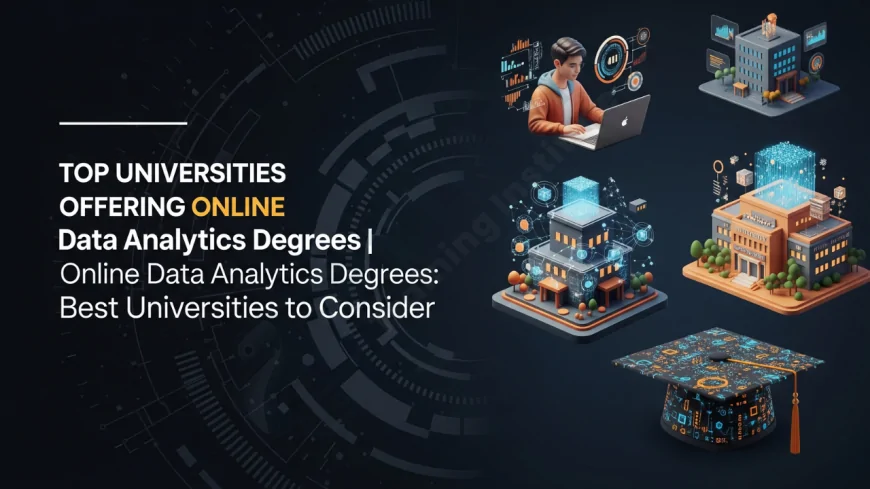
Table of Contents
- Introduction
- Leading Online Bachelor’s Programs
- Top Online Master’s Programs
- Curriculum & Learning Focus
- Admissions & Credentials
- Cost & Duration
- Career Outcomes & Recognition
- How to Choose the Right Program
- FAQs
- Conclusion
Introduction
In 2025, demand for data analytics skills continues to rise. Several universities now offer fully online bachelor’s and master’s degrees in data analytics, blending flexibility with academic rigor. This guide highlights top institutions worldwide, their curriculum strengths, costs, and what makes each program a strong choice. Sources include OnlineU rankings, Research.com, Coursera offerings, and institutional websites.
Leading Online Bachelor’s Programs
- Purdue University Global: Offers a 100% online Bachelor of Science in Analytics with nine concentrations including cloud computing and software development. The program emphasizes real-world analytics tools and decision support.
- Western Governors University (WGU): Fully online and competency-based B.S. in Data Analytics allowing flexible pacing and practical assessments, ideal for working professionals.
- Southern New Hampshire University (SNHU): Offers an accredited online B.S. in Data Analytics with curricula designed for career entry, covering Python, SQL, and SAS fundamentals.
- Washington State University Global (WSU Online): B.S. in Data Analytics with a focus on big data and data science readiness through applied coursework.
- Arizona State University (ASU Online): Bachelor of Science in Business Data Analytics combining technical analytics skills with business and leadership context.
Top Online Master’s Programs
- Georgia Tech – OMS Analytics: Ranked top‑5 nationally, the Online Master of Science in Analytics covers ML, optimization, visualization and statistical modeling from the same faculty as the on-campus program. Self-paced over 24–36 months.
- Boston University: Online M.S. in Applied Data Analytics (~32 credits, ~$17,600) with strong project-based learning and no GRE requirement.
- Southern New Hampshire University: M.S. in Data Analytics (~36 credits, ~$22,900) focused on mining, modeling, and ethical analytics.
- University of Illinois at Springfield: Offers online M.S. with preparation for Oracle SQL and SAS certifications, part-time friendly. (~32 credits)
- Concordia University, St. Paul: Online M.S. emphasizing strategic data-driven decision making, business acumen and analytics methodologies. (~33–36 credits)
Curriculum & Learning Focus
Most bachelor’s programs focus on foundational tools: Excel, SQL, Python/R, and data visualization, integrating portfolio work. Master's programs add advanced topics like machine learning, predictive modeling, big data systems, and business intelligence. Georgia Tech’s OMS program, for example, spans analytics, engineering, and computing tracks.
Admissions & Credentials
Many programs eliminate GRE/GMAT requirements, making them accessible to working professionals and international learners. Accreditation varies by region (e.g., HLC in the U.S.) and credentials are nationally recognized. Georgia Tech’s OMS Online is equivalent to its on-campus degree. University durations range from 24 to 36 months depending on pace.
Cost & Duration
Bachelor’s programs often span 2–3 years. For example, Purdue Global charges ~$371/credit (~36 months) while WGU uses flat-rate tuition. Master’s programs vary: Georgia Tech costs roughly $10,700 total (~36 credits), Boston University ~$17,600, while Concordia or SNHU range $22,500–$23,000. Study part-time or full-time, depending on flexibility needs.
Career Outcomes & Recognition
Degrees from these reputable institutions carry significant value. Georgia Tech and Boston University rank highly for analytics careers, and WGU graduates emphasize competency-based learning. Employers value coursework combined with real-world projects and certifications. Portfolio work, internships, and recruiter connections are critical for job readiness.
How to Choose the Right Program
- Decide on level (Bachelor vs Master) based on prior education.
- Prefer accreditation (e.g. regional) and recognized faculty.
- Check curriculum alignment with your career goals—technical vs business roles.
- Evaluate cost, pace, and flexibility; competency-based vs cohort learning.
- Look for capstone or portfolio requirements for practical experience.
FAQs –
1. Are these online degrees accredited?
Yes. Most are regionally accredited (e.g., HLC) and recognized globally. Georgia Tech and Purdue Global degrees are fully equivalent to on-campus credentials.
2. Do I need GRE/GMAT?
Many programs now waive GRE/GMAT, especially for online tracks—check each university’s admission policies.
3. Which online bachelor’s is best for data analytics?
Purdue Global, WGU, SNHU, and ASU are widely recognized options depending on pacing, cost structure, and focus.
4. Which master’s program is most affordable?
Georgia Tech’s OMS Analytics (~$10,700 total) ranks as one of the most cost-effective full master's options.
5. How long do degrees take?
Bachelor’s: ~24–36 months. Master’s: ~24–36 months depending on full-time or part-time pace.
6. Do programs offer specializations?
Yes—Georgia Tech offers tracks in business analytics, data science, and tools. Purdue Global includes nine concentration options.
7. Are portfolios required?
Most include capstone or applied projects—essential for job readiness and demonstrating skills.
8. Can working professionals manage coursework?
Absolutely—courses are self-paced, mostly asynchronous, and designed for flexibility. WGU allows night/weekend work.
9. Will employers accept online degrees?
Yes—reputable schools and project-based learning ensure graduates are competitive in analytics job market.
10. Are credits transferable?
Depends on university policies—but many allow credit transfer from prior learning or other accredited institutions. Check advisor options.
11. Is financial aid available?
Yes—many institutions offer financial aid, payment plans, military discounts, and employer reimbursement plans.
12. What tools are taught?
Common tools: Python, SQL, Tableau/Power BI, SAS, and cloud tools in advanced programs. Georgia Tech includes machine learning and simulation tools.
13. Can international students enroll?
Yes—online programs are globally accessible, though check residency and time zone accommodations.
14. Are some programs GRE-optional due to COVID changes?
Yes—many schools permanently dropped GRE requirements for flexibility and equity.
15. Do any universities offer dual degrees?
Some, like Purdue and Georgia Tech, offer related dual or combined tracks with computing or business analytics.
16. Is a bachelor’s enough to become a data analyst?
Yes—many analysts start with a bachelor’s degree combined with certifications and projects.
17. Can I upgrade from a bachelor's to a master's later?
Yes—many institutions allow alumni or external students to transition into master's programs. Speak with admissions teams.
18. Do online students get career services?
Yes—career counseling, resume support, recruiter access, and job boards are common features in online programs.
19. Are programs updated regularly?
Top institutions continuously update curriculum; for example, Georgia Tech and ASU refreshed content in 2024–25 to include AI and cloud modules.
20. Where should I start my application?
Begin by shortlisting 3–5 programs that align with your goals, check prerequisites and start deadlines, and gather application materials early.
Conclusion
Online degrees in data analytics now offer flexible, high‑quality options from top universities. Whether starting from scratch at WGU or advancing with Georgia Tech’s OMS, these programs combine rigorous instruction with career applicability. Choose based on your background, budget, and learning preferences—and supplement with portfolios and real-world experience to maximize impact.
What's Your Reaction?
 Like
0
Like
0
 Dislike
0
Dislike
0
 Love
0
Love
0
 Funny
0
Funny
0
 Angry
0
Angry
0
 Sad
0
Sad
0
 Wow
0
Wow
0