



How Data Analysts Use Machine Learning | Data Analysts and Machine Learning: A Powerful Combination
Discover how data analysts apply machine learning for forecasting, anomaly detection, automation, segmentation, and predictive analytics. Learn how ML boosts modern data analysis workflows.
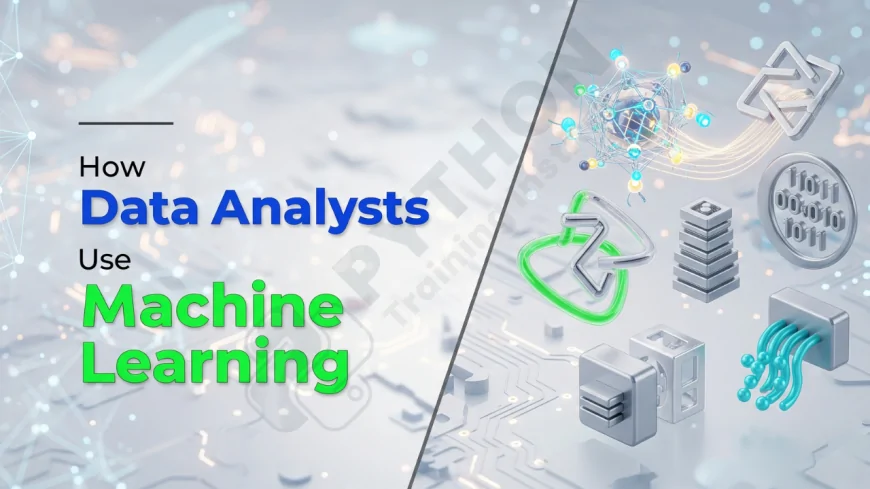
Table of Contents
- Introduction
- Role of Machine Learning for Data Analysts
- Automating Routine Analysis Tasks
- Extracting Hidden Patterns & Trends
- Predictive Modeling & Forecasting
- Anomaly & Fraud Detection
- Segmentation & Customer Profiling
- Using Augmented Analytics & AutoML
- Integration with MLOps & Deployment
- Skills Data Analysts Need in 2025
- Workflow Example
- Common Challenges & Solutions
- FAQs
- Conclusion
Introduction
As data volumes expand, modern data analysts increasingly combine traditional analytics with machine learning (ML). While deep ML expertise remains the domain of data scientists, analysts integrate ML in meaningful ways—automating data prep, enhancing predictions, detecting anomalies, and enabling decision‑driven insights.
Role of Machine Learning for Data Analysts
Machine learning empowers analysts to augment their workflows by automating repetitive tasks and deriving deeper insights from datasets. This shift lets analysts focus more on interpretation and business alignment while ML handles pattern discovery, forecasting, and classification.
Automating Routine Analysis Tasks
ML tools can automate tasks like data cleaning, record deduplication, error detection, and report generation. This saves analysts significant time and reduces manual effort.
Extracting Hidden Patterns & Trends
Analyzing large or complex datasets manually may hide important correlations. ML identifies non-obvious patterns, clusters behaviors, and enables anomaly recognition that traditional summary stats might miss.
Predictive Modeling & Forecasting
Using supervised ML (e.g. regression, classification), analysts build models to forecast outcomes—like churn, demand, or conversion—based on past behavior. Time-series forecasting methods like ARIMA also count as ML when automated.
Anomaly & Fraud Detection
ML is widely applied in fraud and anomaly detection—identifying abnormal transactions, operational issues, or outlier behavior in consumer or machine data. Algorithms like clustering and classification support this.
Segmentation & Customer Profiling
Unsupervised ML techniques such as clustering enable analysts to segment customer groups and define target personas—improving personalization, marketing strategies, and operational efficiency.
Using Augmented Analytics & AutoML
Augmented analytics combines ML with natural language queries and visualization tools to simplify insight generation. Analysts can use AutoML tools like H2O, TPOT, or Azure ML to build models with minimal coding.
Integration with MLOps & Deployment
In advanced environments, analysts collaborate with data engineers and ML teams to deploy ML pipelines through MLOps—ensuring models remain robust, versioned, and aligned with business metrics. Analysts may monitor model health and assist in interpreting model outputs.
Skills Data Analysts Need in 2025
Surveys show that ~97% of analysts now use AI‑powered tools, and ~87% rely on automation in daily workflows. Analysts benefit from knowing basic ML concepts, AutoML frameworks, Python/Scikit‑learn, and visualization tools integrated with ML.
Workflow Example
- Define business question (e.g. forecast demand)
- Extract and clean data
- Explore data and engineer features
- Select ML model (e.g. regression, clustering, AutoML)
- Train model with training/validation/test split
- Evaluate outcomes (MAE, ROC, etc.)
- Integrate model output into dashboards or reports
- Monitor performance via MLOps tools
Common Challenges & Solutions
- Model interpretability: Use simpler models or explainable ML methods.
- Data bias or noise: Ensure proper cleaning and validation.
- Tool complexity: Use AutoML or user-friendly ML tools.
- Deployment gaps: Collaborate with MLOps or engineering teams.
FAQs –
1. Can data analysts use machine learning without being data scientists?
Yes. Analysts can use basic supervised/unsupervised models and AutoML tools for pattern detection, forecasting, and classification without deep ML expertise.
2. What tasks does ML automate for analysts?
Routine tasks like cleaning, error detection, duplicate removal, report generation, and some visualizations can be automated via ML workflows.
3. Is predictive modeling part of a data analyst’s job?
Increasingly yes—many analysts build regression or classification models to forecast trends, churn, or demand based on historical data.
4. What is anomaly detection in analysis?
It’s using ML to flag outliers or fraudulent behavior in datasets—not visible through simple aggregations.
5. Do analysts need to know deep learning?
No—neural networks are often handled by data scientists; analysts focus on classical ML, clustering, tree models, and AutoML frameworks.
6. What is AutoML and why use it?
AutoML automates model selection and tuning—ideal for analysts without ML specialization but wanting reliable models.
7. How does augmented analytics help analysts?
It combines ML with natural‑language queries and visualization—for example, using ML to auto-generate insights or charts.
8. What’s MLOps and is it relevant?
MLOps is the process of deploying, versioning, and monitoring ML models—analysts may collaborate in monitoring and interpreting performance.
9. How much ML do analysts use daily?
Surveys say over 97% use AI tools regularly; around 87% use automation in workflows.
10. Should analysts learn Python ML libraries?
Yes—libraries like scikit-learn, pandas, and AutoML frameworks are increasingly relevant for analytics workflows.
11. Can ML improve visualization?
Yes—ML can suggest visuals, detect key trends, and feed interactive dashboards with predictive inputs.
12. Are clustering and segmentation machine learning?
Yes—unsupervised models like k‑means help segment audiences or behaviors in datasets.
13. What challenges do analysts face with ML?
Challenges include model bias, interpretability, tool complexity, and integration with production workflows.
14. How do analysts validate ML models?
Analysts use training/validation/test splits, cross‑validation, and metrics like MAE, RMSE, accuracy depending on model type.
15. Does ML replace analysts?
No—automation handles routine tasks, but analysts are needed to frame questions, interpret models, and drive action.
16. Can analysts deploy ML models?
With MLOps collaboration, analysts may help monitor deployed models and interpret their business impact.
17. Is ML adoption growing in analyst roles?
Yes—Gartner predicts that by 2025, 80% of analytics solutions will integrate ML.
18. What is predictive analytics?
A subset of ML focused on forecasting future trends, behaviors, transactions based on historical data.
19. What sectors use analyst-led ML?
Retail, finance, healthcare, IoT monitoring, marketing, risk analytics, and BI reporting leverage ML-enabled analytics.
20. How can analysts get started with ML?
Begin by learning structured ML workflows: feature engineering, AutoML tools, clustering, and basic supervised modeling using Python or no-code platforms.
Conclusion
Machine learning significantly enhances a data analyst’s toolkit—automating tedious tasks, uncovering hidden insights, enabling forecasting, and improving decision-quality. While analysts may not build deep neural networks, they leverage ML through AutoML platforms, clustering, predictive modeling, and augmented analytics to deliver strategic business value. As ML democratizes through simpler tools, analysts who adopt ML-savvy workflows will become indispensable in data-driven organizations.
What's Your Reaction?
 Like
0
Like
0
 Dislike
0
Dislike
0
 Love
0
Love
0
 Funny
0
Funny
0
 Angry
0
Angry
0
 Sad
0
Sad
0
 Wow
0
Wow
0