

Common Data Analyst Interview Mistakes to Avoid | How to Avoid Common Data Analyst Interview Fails
Avoid common data analyst interview mistakes like weak storytelling, lack of business context, poor SQL prep, and skipping mock interviews. Learn how to ace your analytics job interview.
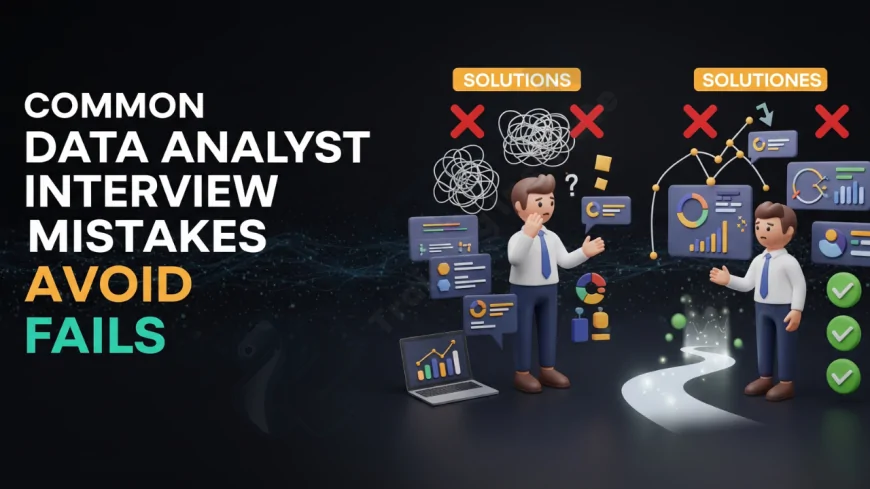
Table of Contents
- Introduction
- Weak Storytelling & Resume Repetition
- Excessive Jargon & Buzzwords
- Lack of Business Context Awareness
- Poor Technical Preparation
- SQL Overkill or Underpreparation
- Poor Communication & Visualization
- Unstructured Case Study Approach
- Neglecting Soft Skills & Behavioral Questions
- Skipping Mock Interview Practice
- Lack of Integrity or Misrepresentation
- Not Asking Thoughtful Questions
- Overlong or Rambling Replies
- Ignoring Bias and Assumptions
- Neglecting Documentation & Model Tracking
- Misusing Visualization without adequate context
- Focusing on Tools Over Analytical Thinking
- Stagnation—Not Staying Updated
- FAQs
- Conclusion
Introduction
Job interviews for data analyst roles are multifaceted—they assess not only technical knowledge but also communication, problem-solving, and business acumen. Unfortunately, many strong candidates trip up on avoidable missteps. In this guide, we'll cover the most common pitfalls and how to steer clear of them to present your best self.
Weak Storytelling & Resume Repetition
A common mistake is simply reading your resume—or repeating achievements without narrative clarity. Instead, use storytelling frameworks like STAR or SARL to showcase your journey with context, impact, and reflection.
Excessive Jargon & Buzzwords
Using buzzwords like “neural networks” or “clustering” without business relevance makes you appear robotic. Opt for clear, example-based explanations such as:
"I used Python to automate a daily report, saving 2 hours per week."
This improves clarity and engagement.
Lack of Business Context Awareness
Data analysis without business context can lead to irrelevant insights. Interviewers expect you to connect metrics and recommendations to business goals to demonstrate relevance.
Poor Technical Preparation
Many enter interviews underprepared on essential tools—even entry-level roles expect proficiency in SQL, Python, and visualization. Practice via relevant platforms—keep projects grounded in real-world scenarios.
SQL Overkill or Underpreparation
Overdoing LeetCode-style SQL can backfire; analytics interview tests focus on clear, business-oriented queries. Instead, focus on StrataScratch and HackerRank style problems, and ensure optimized use of joins, partitioning, and CTEs where needed.
Poor Communication & Visualization
Being unable to provide context, narrative, or actionable insights undermines your analysis. Effective visuals must be clear, contextual, and tailored to stakeholder understanding.
Unstructured Case Study Approach
Avoid jumping straight to code or charts. Instead, clarify objectives, key metrics, assumptions, and structure your approach using frameworks like CRISP-DM or BADIR.
Neglecting Soft Skills & Behavioral Questions
Focusing solely on technical answers while omitting examples of teamwork or stakeholder management is a missed opportunity. Frame your behavioral responses around collaboration, communication, and learning.
Skipping Mock Interview Practice
Entering interviews without practicing under pressure can lead to fumbling, rambling, and lack of clarity. Aim for 5–10 practice interviews with peers or mock platforms, reviewing tone and clarity each time.
Lack of Integrity or Misrepresentation
Misstating skills or credentials is a high-risk error. It's better to be honest and express willingness to learn than to unravel under questioning.
Not Asking Thoughtful Questions
Interviews are two-way conversations. Neglecting to ask questions about team structure, KPI ownership, or data strategy misses a key opportunity to demonstrate engagement and curiosity.
Overlong or Rambling Replies
Lengthy, unfocused answers lose listener interest. Aim for clarity and crispness—1–2 minute responses are ideal, especially using structured frameworks.
Ignoring Bias and Assumptions
Miscalculating correlation versus causation, failing to identify sampling bias, or cherry‑picking data can ruin credibility. Always validate assumptions and avoid selective data interpretation.
Neglecting Documentation & Model Tracking
Failing to track analysis steps, assumptions, or model versions can lead to irreproducibility and accountability lapses. Use Git and clear README files to document your workflow.
Misusing Visualization without Context
A dashboard chart without insights or relevance confuses viewers. Always anchor visuals with context: “This chart shows a 10% uptrend in churn over the last quarter compared to benchmarks.”
Focusing on Tools Over Analytical Thinking
Mastering tools without developing critical thinking (ask why, test assumptions, question results) is a strategic weakness. Employers look for applied thinking—not just tool fluency.
Stagnation—Not Staying Updated
Falling behind on industry trends, new tools, or data practices can hurt your competitiveness. Commit to continuous learning through online courses, projects, and relevant communities.
Frequently Asked Questions (FAQs)
1. What is the biggest mistake in analyst interviews?
Relying too much on technical tools and ignoring business context and storytelling.
2. Should I memorize SQL queries?
No. Focus on understanding business use cases and clear, efficient query writing.
3. How can I improve my storytelling?
Use STAR or SARL formats to narrate impactful results, not just list tasks.
4. Is jargon bad in interviews?
Overuse of technical terms can confuse—explain with real examples and business value.
5. How many mock interviews are ideal?
At least 5–10 with feedback to improve pacing and answer structure.
6. What if I don’t know a technical answer?
Clarify the question, explain your thought process, and show willingness to think through it.
7. Are behavioral questions important?
Yes—they demonstrate how you handle collaboration, challenges, and conflict.
8. Should I ask questions at the end?
Definitely—ask about team KPIs, data tools, growth path, or role-specific challenges.
9. What's worse: tools or assumptions?
Misguided assumptions lead to flawed insights more than tool errors—always validate assumptions.
10. How do I avoid overfitting?
Use simpler models, cross-validation, and test with unseen data to ensure robustness.
11. Can poor documentation affect interviews?
Yes—lack of version or process tracking raises concerns around reproducibility.
12. Should I tailor my resume to each job?
Absolutely—highlight relevant projects, skills, and contributions aligned with the role.
13. What if I’m nervous on the day?
Breathe, structure your answers, and focus on clarity—not perfection.
14. How long should answers be?
Keep behavioral or technical responses concise: ideally 1–2 minutes with clear structure.
15. Is over-preparation risky?
Yes—too much memorization appears inauthentic. Be rehearsed, not robotic.
16. Should I show negative examples or mistakes?
Yes—highlight failures with reflections via SARL to show growth and authenticity.
17. What visuals are best for interviews?
Simple charts—bar, line, heatmap—supported by clear storytelling and labels.
18. How to handle missing data questions?
Explain cleaning steps: imputation, filtering, documentation, and rationale.
19. Should I talk about industry trends?
Yes—briefly mention awareness of trends, tools, and domain knowledge, especially if relevant.
20. How to show problem-solving skills?
Use structured frameworks like CRISP‑DM, walk through steps, clarify assumptions, and summarize outcomes.
Conclusion
Avoiding these common pitfalls—including poor storytelling, jargon misuse, weak technical preparation, and lack of business context—can elevate your interview performance significantly. Pair diligent mock practice with clear communication and structured analytical thinking, and you'll stand out as a candidate who delivers both insight and impact.
What's Your Reaction?
 Like
0
Like
0
 Dislike
0
Dislike
0
 Love
0
Love
0
 Funny
0
Funny
0
 Angry
0
Angry
0
 Sad
0
Sad
0
 Wow
0
Wow
0