
Google Data Analytics Certification Review | Google Data Analytics Certification: What You Need to Know
Detailed review of the Google Data Analytics Professional Certificate on Coursera. Learn about course structure, pros and cons, real-world relevance, job impact, and how it compares with other certifications.
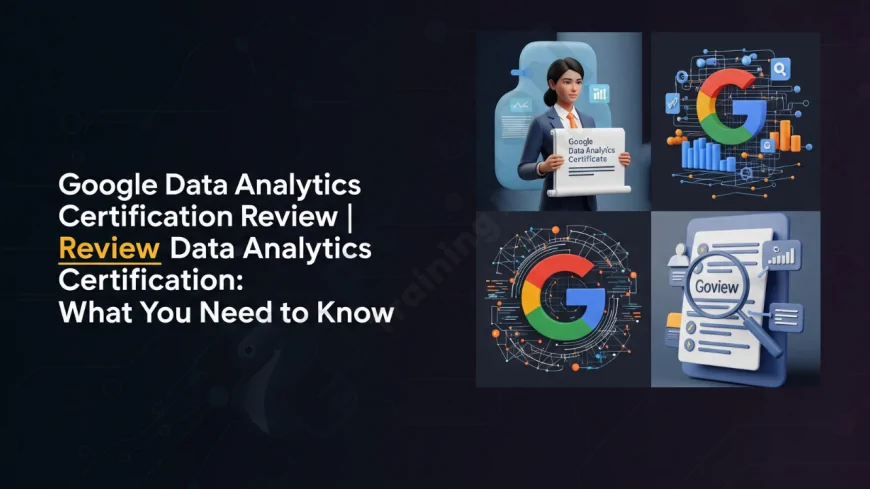
Table of Contents
- Course Overview
- Key Strengths
- Limitations & Gaps
- Capstone Project Experience
- Career Impact & Outcomes
- Comparison with Other Certifications
- FAQs
- Conclusion
Course Overview
The Google Data Analytics Professional Certificate on Coursera is an eight-course sequence covering the end-to-end analytics life cycle: asking questions, preparing data, cleaning, analyzing, visualizing, and presenting insights, plus a capstone case study. It also includes a module on R programming and optional job preparation materials.
Key Strengths
- Beginner-friendly structure: Designed for learners with no prior experience; explains fundamentals clearly.
- Well-organized curriculum: Each module builds on the previous, covering spreadsheets, SQL, Tableau, R, and analytics thinking coherently.
- Global recognition: Google-branded credential has credibility; many employers recognize it, with some data showing ~75% graduates saw career progress within six months.
- Career preparation support: Resume tips, mock interview practice, and job-seeking resources included, especially in the capstone.
Limitations & Gaps
- Technically basic: SQL, Tableau, and R content is introductory—learners often report needing more practice and advanced training afterward.
- Lack of Python coverage: Does not include Python, which is more widely used in the industry.
- No live instruction: Fully self‑paced—forums exist, but no live mentoring or interactive classroom experience.
- Capstone too challenging/unstructured: Many learners found it overwhelming without guided support.
Capstone Project Experience
The capstone invites learners to apply the analytics process in a case study—choosing or sourcing a dataset, asking business questions, cleaning, analyzing, and visualizing results. It simulates real-world analytics work, although some users felt underprepared.
Career Impact & Outcomes
While not a guarantee of job placement, the certificate is a recognized foundation. Reddit learners emphasize that follow-up with deeper tools and personal projects is essential for landing roles. Data indicates many graduates see career progress or job transitions shortly after completion.
Comparison with Other Certifications
| Certificate | Focus | Best For | Limitations |
|---|---|---|---|
| Google Data Analytics | R, SQL, Tableau, spreadsheets | Absolute beginners | No Python; basic tool depth |
| IBM Data Analyst (Coursera) | Python‑based analysis, Cognos | More technical learners | Requires Python background |
| Meta Data Analyst (Coursera) | Python, SQL, marketing analytics | Portfolio-first, Python focus | Shorter; less R/Tableau |
| Microsoft PL‑300 / Power BI | Data visualization & BI dashboards | Roles centered on Power BI | No SQL or R depth |
FAQs –
1. Is this course suitable for complete beginners?
Yes—it is explicitly designed for learners without prior analytics experience.
2. How long does it take to complete?
Estimated at ~140–240 hours. Many complete in 2–3 months full-time or up to six months at 10 hours/week.
3. Is Python included?
No. The course introduces R but lacks Python, which may limit applicability for many corporate roles.
4. How recognized is the certificate?
Google’s brand adds prestige. Many hiring managers consider it credible for entry-level jobs.
5. Is the capstone project required?
No—but completing it greatly enhances learning and portfolio value. It simulates real-world data analysis workflow.
6. Are assignments graded?
Yes—all graded modules must meet a minimum score (~80%) to progress and earn certification.
7. Do I get instructor feedback?
No live feedback. You rely on self-study and discussion forums.
8. Can it make me job-ready?
Partly—it provides foundation, but job-readiness depends on adding personal projects, deeper tool practice, and interview preparation.
9. What tools are covered?
Spreadsheets (Excel/Sheets), SQL, Tableau, R programming, and basic analytics thinking.
10. Is AI content included (2025 update)?
Recent curriculum updates introduce basic AI-enhanced workflows tied to data cleaning, presentation, and automated logic.
11. How does it compare to IBM’s certificate?
IBM emphasizes Python, technical depth, and data manipulation—suited for more technical learners.
12. Are there real-world cases?
Yes—the capstone project allows learners to perform a full analytics case study.
13. Can experienced learners benefit?
Not as much—they may find the content too basic and may benefit more from intermediate or advanced certifications.
14. What job-focused support is included?
Career resources: resume templates, behavioral interview guidance, capstone examples, and mock interview guidance.
15. Is R worth learning?
Yes—R skills are valuable in academic or statistics-heavy roles, though Python is more mainstream in industry.
16. Does completing the certificate guarantee a job?
No—career success depends on supplementing the certificate with practice, projects, and soft skill development.
17. Can costs be reduced?
Yes—options include Coursera Plus subscription, financial aid, or employer-sponsored access.
18. What’s the average learner rating?
Over 4.8/5 on Coursera with nearly one million enrollments and extensive positive feedback.
19. Is the course updated regularly?
Yes—the 2025 edition incorporates AI tools and updated analytics workflow content.
20. What should I do after completing this certificate?
Continue learning SQL, Python, Tableau/PBI; build projects; pursue advanced or specialized programs; engage in communities; and apply strategically.
Conclusion
The Google Data Analytics Professional Certificate is an excellent foundational credential for beginners in 2025. Its structured curriculum, reputation, and career resources make it a top entry point into analytics. However, it is not comprehensive—students often need to supplement with further learning in Python, advanced SQL, BI tools, and hands-on projects. With ambition and follow-up work, it can form a solid base for launching an analytics career.
What's Your Reaction?
 Like
0
Like
0
 Dislike
0
Dislike
0
 Love
0
Love
0
 Funny
0
Funny
0
 Angry
0
Angry
0
 Sad
0
Sad
0
 Wow
0
Wow
0