
Skills You Need to Become a Senior Data Analyst | Top Skills Every Senior Data Analyst Must Have
Discover the essential skills required to become a senior data analyst, including technical tools like SQL, Python, data visualization, machine learning, and key soft skills such as storytelling, business acumen, and leadership.
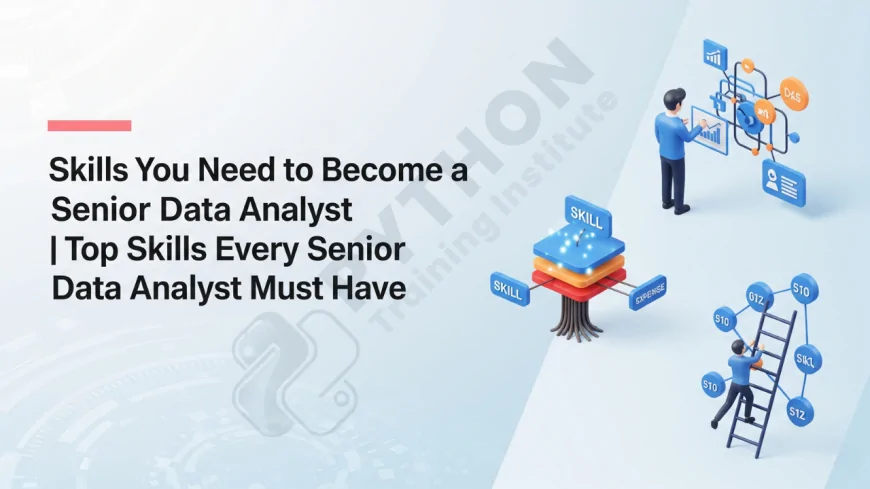
Table of Contents
- Introduction
- Core Technical Skills
- Advanced Analytical & Statistical Skills
- Business Acumen & Domain Knowledge
- Essential Soft & Human‑Centric Skills
- Tool Proficiency & Emerging Technologies
- Leadership & Mentoring Skills
- FAQs
- Conclusion
Introduction
Senior data analysts have evolved beyond basic reporting—they are strategic advisors who translate complex data into insights that drive decisions. This requires a sophisticated combination of technical mastery, analytical depth, business awareness, and strong interpersonal abilities. The skills detailed below draw upon recent expert guidance and industry trends shaping the senior analyst role in 2025.
Core Technical Skills
- Advanced SQL & Data Warehousing: Master complex joins, window functions, partitions, indexing, and ETL pipelines. Senior analysts often manage data across enterprise-grade platforms.
- Statistical Programming: Fluency in Python (pandas, NumPy) or R for analysis and automation. These are key in complex modeling and scripting repetitive tasks.
- Data Visualization & BI Tools: Expert at Tableau, Power BI, or Looker for dashboards and storytelling. Ability to design intuitive, interactive visual narratives.
- Data Management: Knowledge of warehousing, data governance, cleaning, integrity checks, and metadata documentation.
Advanced Analytical & Statistical Skills
- Predictive Modeling & Machine Learning: Understanding regression, classification, clustering, and basic ML methods. Applying models to forecast outcomes and detect patterns.
- Statistical Thinking: Comfort with hypothesis testing, probability, distributions, and causal inference ensures insights are valid.
- Creative & Critical Thinking: Ability to combine diverse data sources, question assumptions, and propose innovative solutions.
Business Acumen & Domain Knowledge
Senior analysts must connect data insights to business outcomes. They should:
- Understand business KPIs: Tie analytics to metrics like churn, customer lifetime value, conversion rate, and ROI.
- Know your domain: Whether finance, healthcare, retail or SaaS, deep knowledge helps frame analysis in meaningful context.
- Strategic mindset: View data as a tool for optimization—not just reporting—to drive change and innovation.
Essential Soft & Human‑Centric Skills
- Communication & Storytelling: Translate complex findings into simple, compelling narratives for various stakeholders.
- Critical Thinking & Ethical Awareness: Apply unbiased reasoning, question the data, and ensure ethical interpretations.
- Collaboration & Empathy: Work effectively across teams, mentor juniors, negotiate priorities, and align on goals.
- Adaptability & Resilience: Juggle shifting priorities, changing tools or shifting project scopes fluently.
Tool Proficiency & Emerging Technologies
- Big Data Platforms: Experience with Spark, Hadoop, Snowflake, or Redshift for large-scale processing.
- Cloud Analytics: Familiarity with AWS, Azure, or GCP services—Redshift, BigQuery, SageMaker for scalable solutions.
- Machine Learning Tools: Understanding toolchains like scikit-learn, TensorFlow, or low-code platforms for model deployment.
Leadership & Mentoring Skills
At the senior level, you are expected to:
- Guide junior analysts through methodology, review practices, and career growth.
- Lead analytic projects end-to-end—from scoping to presentation.
- Influence stakeholders with clarity, authority, and thoughtful business context.
FAQs –
1. What are the must-have technical skills?
Proficiency in SQL, Python/R, data visualization tools like Tableau or Power BI, and elementary ML modeling.
2. Do senior analysts need coding skills?
Yes—Python or R scripting is expected for automation, analysis, and modeling.
3. Is business acumen required?
Absolutely—it lets analysts align insights with strategic business goals.
4. Are soft skills as important as technical skills?
Yes—critical thinking, communication, empathy, and mentoring are key leadership skills.
5. What analytics frameworks should I know?
Be familiar with CRISP‑DM, BADIR, and the analytics lifecycle—understanding problem framing, data prep, modeling, and evaluation.
6. How much machine learning is required?
Basics of regression, classification, clustering, and evaluation metrics—enough to build predictive models.
7. Should I learn cloud platforms?
Yes—knowing cloud services like AWS/GCP/Azure for data storage and analytics enhances scalability and performance.
8. How do I build domain knowledge?
Work on projects in a specific sector, network within that industry, and stay updated on relevant trends.
9. Is mentoring experience important?
Yes—leading junior analysts demonstrates leadership and is often expected at the senior level.
10. Which BI tools should I learn?
Tableau, Power BI, Looker, or Cognos—focus on creating dashboards that tell clear stories.
11. How do I improve storytelling skills?
Practice presenting findings with context, visuals, key takeaways—and refine based on feedback.
12. Are ethical awareness skills necessary?
Yes—you're expected to identify bias, handle sensitive data responsibly, and maintain trust.
13. Can senior analysts work remotely?
Yes—with strong communication and collaboration skills to align across teams and time zones.
14. What certifications help?
Certificates in data analytics, machine learning, cloud platforms (AWS, GCP), Tableau or Power BI can strengthen your profile.
15. Should I specialize?
Specializing in a domain (finance, healthcare, product analytics) can boost your tailored impact and value.
16. How do I gain big data experience?
Work on projects using Spark, Hive, Snowflake, or unstructured datasets requiring ETL design.
17. Is project management part of the role?
Often—senior analysts lead project timelines, resource allocation, and stakeholder coordination.
18. How important is adaptability?
Very—senior analysts must pivot under shifting business demands and technical changes.
19. How do I get feedback?
Seek peer review, join analytics communities like LinkedIn or Reddit, and ask mentors for critique.
20. What mindset helps support growth?
Be curious, open to feedback, proactive in learning, and focused on delivering business value via data.
Conclusion
Becoming a senior data analyst in 2025 demands bridging technical depth and human-centric leadership. You should master SQL, Python/R, data modeling, and BI tools while developing critical thinking, storytelling, domain understanding, and ethical judgment. By combining these skills with real projects and mentoring roles, you position yourself to lead analytics initiatives and influence business strategy.
What's Your Reaction?
 Like
0
Like
0
 Dislike
0
Dislike
0
 Love
0
Love
0
 Funny
0
Funny
0
 Angry
0
Angry
0
 Sad
0
Sad
0
 Wow
0
Wow
0