



Preparing for Advanced SQL Interviews for Data Analyst Roles | How to Prepare for Advanced SQL Interviews as a Data Analyst
Master advanced SQL interview preparation for data analyst roles. Learn complex queries, window functions, recursive CTEs, optimization tips, and real-world problem-solving strategies.
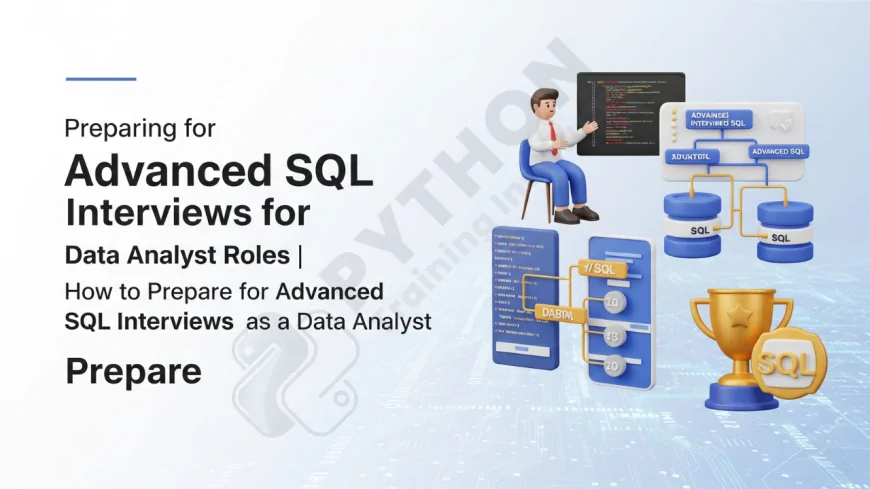
Table of Contents
- Introduction
- Key SQL Concepts to Master
- Interview Strategy & Approach
- Advanced Real-World SQL Challenges
- Performance & Optimization Techniques
- How to Practice Effectively
- FAQs
- Conclusion
Introduction
SQL remains the cornerstone of data analysis workflows in 2025. For data analyst candidates, mastering advanced SQL—such as window functions, recursive CTEs, query optimization, and scenario-based logic—is often the differentiator in technical interviews. This guide provides a step‑by‑step roadmap to prepare for high‑stakes SQL interviews.
Key SQL Concepts to Master
- Joins & Subqueries: Inner, outer, self-joins; correlated vs nested subqueries—understand their differences and use-cases.
- Window Functions: Learn ROW_NUMBER, RANK, LAG, LEAD, moving averages and running totals—widely tested in analyst interviews.
- CTEs & Recursive Queries: Break down complex logic into legible steps—important for hierarchical or repeated data patterns.
- Set Operations: UNION, INTERSECT, EXCEPT/ MINUS for combining query results cleanly.
- Aggregation & Filtering: HAVING vs WHERE, grouping logic, and ROll-UPS or CUBE usage.
Interview Strategy & Approach
According to expert guides, your SQL interview answers should go beyond correctness—your queries should be clean, maintainable, and explainable. Steps include:
- Clarify the problem and schema: Always restate in your own words and ask about nulls or keys.
- Break tasks into subqueries: Build queries iteratively rather than writing a massive monolith.
- Explain your logic out loud: Describe why you choose certain joins, filters, or window functions.
Advanced Real‑World SQL Challenges
Many advanced SQL interview questions simulate realistic problems:
- Duplicate transactions within time windows: e.g. detect payments made twice within 10 minutes—requires window functions and timestamp logic.
- Rank and percentiles: Use window functions to rank customers or compute median values over partitions.
- Hierarchical chain traversal: Build organizational or tree-level summaries using recursive CTEs.
Performance & Optimization Techniques
Interviewers often ask how to make queries more efficient—expect to discuss:
- Index usage, composite indexes, and avoiding full table scans.
- Filtering early vs late, join order, and minimizing subquery overhead.
- Explain plans & analyzing execution strategies to identify bottlenecks.
How to Practice Effectively
Recommended tactics to excel in advanced SQL interviews include:
- Use platforms like Interview Query, StrataScratch, and DataLemur for scenario-based exercises.
- Time-bound practice: simulate real test conditions (60–90 minutes for 2–3 complex questions).
- Write queries cleanly: avoid overly short aliases, nest logically, and comment steps when appropriate.
- Practice live coding and whiteboard style, verbalizing thought process as you build logic.
FAQs –
1. What distinguishes advanced SQL from basic SQL?
Advanced SQL involves window functions, recursive CTEs, query optimization, and set operations beyond basic SELECTs and joins.
2. What are window functions and why are they important?
Windows functions like LAG, RANK, SUM OVER allow calculations across row partitions—key to ranking or cumulative analyses.
3. When should I use a recursive CTE?
For hierarchical or tree-structured data, recursive CTEs let you traverse parent-child relations cleanly.
4. How do I optimize a slow SQL query?
Use indexes, reduce joins, filter early, analyze execution plans, and avoid unnecessary subqueries.
5. What's the difference between correlated and nested subqueries?
Correlated subqueries refer to the outer query row-by-row; nested do not—important distinction in performance and usage.
6. How should I structure my approach during an SQL interview?
Clarify requirements, plan logic, write subqueries stepwise, test incrementally, and explain your reasoning aloud.
7. What are set operations used for?
UNION, INTERSECT, EXCEPT combine result sets logically—useful for merging multiple query outputs.
8. Are coding style and naming conventions evaluated?
Yes—clean queries with meaningful aliases and logical structure improve readability and perception.
9. What are common interview pitfalls?
Skipping clarifications, writing messy nested queries, and failing to explain trade-offs under time pressure.
10. How many practice problems should I attempt?
Focus on mastering a core set of 15–25 scenarios deeply, especially those involving optimization or edge logic.
11. Should I use recursive queries in take-home tests?
Yes—if needed. But ensure performance scales and syntax clarity meets interview standards.
12. How to handle NULLs in analytics queries?
Use IS NULL, COALESCE(), and be explicit in joins or aggregations—NULL handling often affects correctness.
13. How important are execution plans?
Crucial—they help identify inefficiencies and demonstrate performance awareness to interviewers.
14. Can I divide a complex question into smaller parts?
Absolutely—breaking tasks into modular CTEs or subqueries is considered best practice.
15. Do I need to memorize syntax?
Understanding concepts matters more than memorizing syntax—focus on logic and explanation.
16. Is interview pressure a real concern?
Yes—simulate timed practice to build calmness and mental clarity under interview conditions.
17. Are platform-specific functions tested?
Yes—e.g. GROUP_CONCAT in MySQL, string/date functions. Always note your target dialect in answers.
18. How do I handle ambiguous problem statements?
Ask clarifying questions—e.g. about missing data, key uniqueness—demonstrating analytical thinking.
19. Should I learn query tuning tools?
Yes—familiarity with EXPLAIN plans, indexing principles, partitions shows maturity in SQL skillset.
20. What mindset helps crack SQL interviews?
Be systematic, clear, performance-aware, and business-oriented—solve with intent, communicate thoroughly, and iterate thoughtfully.
Conclusion
Mastering advanced SQL is essential to secure data analyst roles—especially at mid to senior levels. Focus on understanding window functions, recursive logic, performance optimization, and code clarity. Practicing business-oriented scenarios with clean, explainable queries will set you apart in interviews. Structured preparation using real-world tools, timed challenges, and strong logic articulation prepares you not only to answer but to impress.
What's Your Reaction?
 Like
0
Like
0
 Dislike
0
Dislike
0
 Love
0
Love
0
 Funny
0
Funny
0
 Angry
0
Angry
0
 Sad
0
Sad
0
 Wow
0
Wow
0