



Preparing a Capstone Project for Data Analytics Certification | Step-by-Step Guide to a Successful Data Analytics Capstone
Learn how to prepare a high-impact capstone project for your data analytics certification. Explore topic ideas, tools, techniques, and real-world tips to showcase your data skills and impress employers
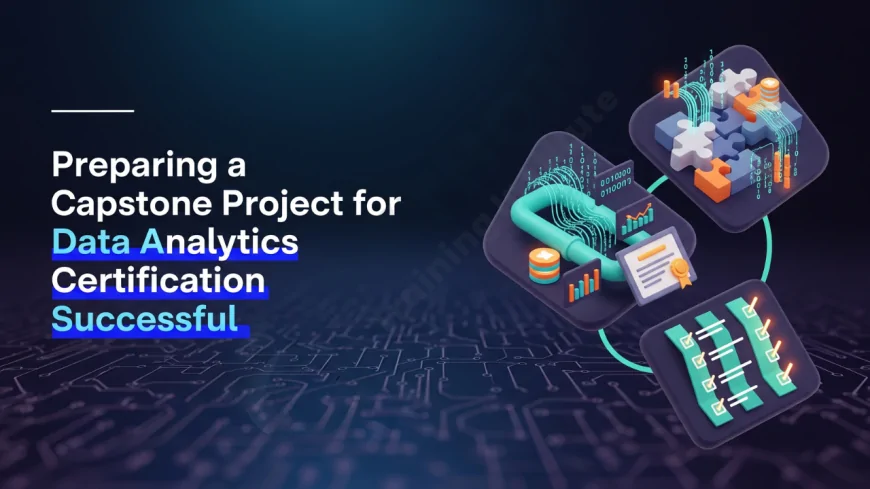
Table of Contents
- Introduction
- What is a Capstone Project?
- Why Capstone Projects Matter in Analytics
- Choosing the Right Topic
- Data Collection and Cleaning
- Exploratory Data Analysis (EDA)
- Applying Statistical and Machine Learning Models
- Data Visualization and Storytelling
- Popular Tools and Technologies
- Sample Capstone Project Ideas
- How to Present Your Capstone
- What Evaluators Look For
- Tips for a Successful Capstone Project
- Common Mistakes to Avoid
- Using Capstone in Your Resume and Portfolio
- FAQs
- Conclusion
Introduction
A capstone project is the pinnacle of any data analytics certification program. It tests not just your technical skills but your ability to think analytically, solve real-world problems, and communicate insights effectively. This guide will walk you through the process of preparing a capstone project that is both impactful and resume-worthy.
What is a Capstone Project?
A capstone project is a comprehensive, hands-on assignment that brings together the skills learned during a course. It typically involves solving a real or simulated business problem using data analysis techniques. Think of it as your chance to demonstrate you’re job-ready.
Why Capstone Projects Matter in Analytics
- They showcase your end-to-end data handling ability.
- They help demonstrate practical experience to employers.
- You apply theory to a real-world scenario, reinforcing learning.
- Often used as a portfolio piece in interviews.
Choosing the Right Topic
Picking the right topic is the most important first step. Consider the following when selecting a project:
- Your personal interests (sports, finance, healthcare, etc.)
- Availability of data (Kaggle, government datasets, company open data)
- Relevance to current industry problems (churn prediction, fraud detection, etc.)
Data Collection and Cleaning
Capstone projects must use clean, reliable data. Collect data from trusted sources like Kaggle, UCI Machine Learning Repository, or web scraping (if permitted).
Use tools like Python (Pandas) or Excel to clean missing values, handle outliers, and standardize formats.
Exploratory Data Analysis (EDA)
This step helps you understand your data’s structure. Include:
- Summary statistics (mean, median, std dev)
- Correlation matrix
- Histograms, boxplots, scatter plots
Tools: Python (Matplotlib, Seaborn), Power BI, Tableau
Applying Statistical and Machine Learning Models
Choose your model based on the problem type:
- Classification: Logistic Regression, Decision Trees
- Regression: Linear Regression, Ridge, Lasso
- Clustering: K-Means, Hierarchical Clustering
Data Visualization and Storytelling
Visuals help communicate your findings effectively. Don’t overload charts; choose meaningful graphs:
- Bar charts for comparisons
- Line graphs for trends
- Heatmaps for correlations
Popular Tools and Technologies
- Languages: Python, R, SQL
- Visualization: Tableau, Power BI, Seaborn, Matplotlib
- Libraries: Pandas, Scikit-learn, NumPy, Plotly
Sample Capstone Project Ideas
- Customer churn prediction using telecom dataset
- Airbnb price prediction based on listing features
- Sales forecasting for a retail store
- Sentiment analysis on Twitter data for a brand
How to Present Your Capstone
- Start with the problem statement
- Describe the dataset and approach
- Highlight key insights and visualizations
- End with business recommendations
What Evaluators Look For
- Clear problem definition
- Logical and structured approach
- Quality of EDA and modeling
- Business insights and communication
Tips for a Successful Capstone Project
- Choose a topic you enjoy
- Start early to avoid last-minute stress
- Keep your analysis simple but impactful
- Review others’ projects on GitHub or Kaggle
Common Mistakes to Avoid
- Choosing an overly complex or vague topic
- Ignoring data quality issues
- Overfitting models with too many features
- Lack of clear storytelling in presentation
Using Capstone in Your Resume and Portfolio
Include your capstone under “Projects” on your resume. Link to GitHub repositories, Tableau dashboards, or PDF reports. Explain your role and the impact in interviews.
FAQs –
1. What is a capstone project in data analytics?
It’s a final project that integrates all course concepts to solve a real or simulated data problem using analysis, modeling, and visualization.
2. Is a capstone project mandatory for certification?
Most data analytics certifications require it as a final evaluation step.
3. Where can I get data for my capstone?
You can use Kaggle, government portals, open data repositories, or web scraping (if ethical/legal).
4. How long does it take to complete a capstone?
Typically 2–4 weeks depending on scope and complexity.
5. What tools should I use?
Python, SQL, Tableau, Excel, Power BI, R—depending on what you’ve learned.
6. Do I need to code for a capstone?
Yes, most projects require at least basic coding in Python, R, or SQL.
7. Can I do a group capstone?
Some programs allow group projects, but individual work is more common.
8. How do I choose a topic?
Pick something you're interested in and that aligns with your career goals and available data.
9. Should I use machine learning?
Only if it adds value. Simple models with strong insights are often better than complex ones.
10. What is EDA?
Exploratory Data Analysis involves understanding the dataset through summary statistics and visualizations.
11. How important is data cleaning?
Critical. Clean data leads to better models and credible results.
12. Do I need to submit a report?
Most programs require a written report or presentation slide deck along with your code or dashboard.
13. What format should my project follow?
Introduction → Data → EDA → Modeling → Results → Conclusion → Business Recommendations.
14. Can I use Excel for my capstone?
Yes, especially for simpler analysis or dashboards, though coding adds more depth.
15. How do I visualize my findings?
Use tools like Tableau, Power BI, Seaborn, or Matplotlib to create insightful graphs.
16. What if I make a mistake in the analysis?
Explain your reasoning. Demonstrating learning and reflection is often more important than perfection.
17. Can I reuse a Kaggle competition dataset?
Yes, but ensure your approach and solution are unique.
18. How long should the final report be?
Generally 5–15 pages/slides, depending on the program.
19. Will my capstone help in job interviews?
Absolutely! It demonstrates your practical abilities and problem-solving skills.
20. Should I upload my capstone on GitHub?
Yes! Hosting your project publicly enhances your portfolio and credibility with recruiters.
Conclusion
Completing a well-thought-out capstone project proves you’re capable of applying analytical thinking to real data problems. From defining your problem and collecting data to communicating insights and modeling, every step reflects your competence as a data analyst. Invest time, focus on clarity, and most importantly—tell a story with your data.
What's Your Reaction?
 Like
0
Like
0
 Dislike
0
Dislike
0
 Love
0
Love
0
 Funny
0
Funny
0
 Angry
0
Angry
0
 Sad
0
Sad
0
 Wow
0
Wow
0