



Learn Data Analytics with Real-World Case Studies | Data Analytics Training with Real Case-Based Learning
Learn data analytics through real-world case studies across industries like retail, finance, healthcare, and marketing. Discover practical tools, skills, and free datasets to build your analytics portfolio and career.
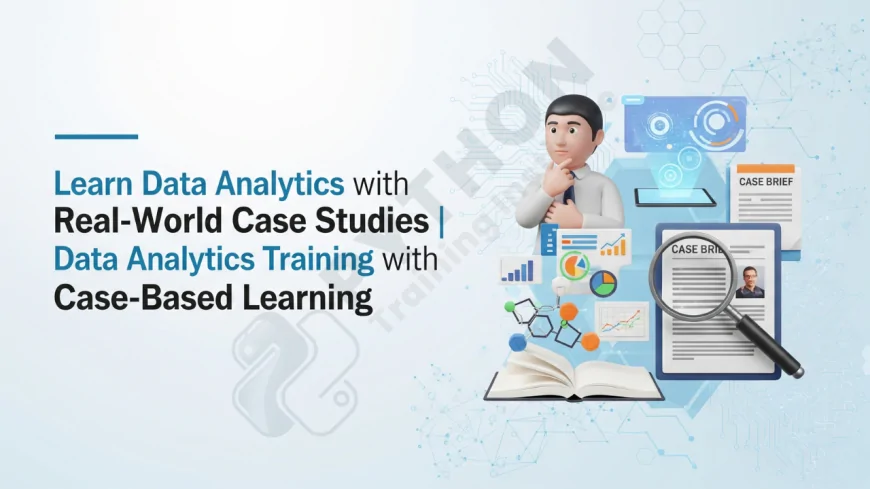
Table of Contents
- Introduction
- Why Case Studies Matter in Data Analytics
- Types of Real-World Case Studies
- Case Study: Retail Sales Forecasting
- Case Study: Predictive Analytics in Healthcare
- Case Study: Fraud Detection in Banking
- Case Study: Customer Segmentation in Marketing
- Case Study: Supply Chain Optimization
- Tools and Skills Required to Analyze Case Studies
- How to Get Started with Case Study-Based Learning
- Free Real-World Datasets to Practice
- Career Impact of Learning Through Case Studies
- FAQs
- Conclusion
Introduction
Data analytics is transforming how organizations operate. Learning through real-world case studies helps bridge the gap between theory and practice. This approach builds critical thinking, problem-solving, and hands-on data analysis skills.
Why Case Studies Matter in Data Analytics
- Real context: Understand how companies make decisions based on data.
- Problem-solving: Apply analytical techniques to actual business problems.
- Portfolio-building: Use your solutions as projects for job interviews.
Types of Real-World Case Studies
- Retail Analytics
- Healthcare Predictions
- Financial Fraud Detection
- Customer Behavior Analysis
- Manufacturing Optimization
- HR Analytics
- Sports Performance Analytics
- Social Media & Sentiment Analytics
Case Study: Retail Sales Forecasting
- Problem: A large retail chain needed to accurately predict weekly sales to manage inventory and reduce overstock or stockouts.
- Approach: Analysts used historical sales data, promotions, holidays, and store types to build a time-series forecasting model using Python (ARIMA/XGBoost).
- Tools: Python, pandas, matplotlib, scikit-learn, and statsmodels were used for data preprocessing and forecasting.
- Outcome: The forecasting model improved inventory turnover by 15% and reduced waste, leading to higher customer satisfaction and cost savings.
Case Study: Predictive Analytics in Healthcare
- Problem: A hospital network wanted to reduce patient readmission rates and improve post-discharge care planning.
- Approach: Patient data including demographics, diagnosis, length of stay, and treatment history were used to build predictive models using logistic regression and random forests.
- Tools: Python, scikit-learn, Jupyter Notebooks, and EHR-integrated data sources were used to develop and deploy models.
- Outcome: The model successfully identified high-risk patients, leading to targeted interventions and an 11% reduction in readmissions within 30 days.
Case Study: Fraud Detection in Banking
A bank leveraged anomaly detection to monitor millions of transactions. Using unsupervised learning (e.g., Isolation Forests), they flagged fraudulent activity in real-time, saving over ₹10 crore annually.
Case Study: Customer Segmentation in Marketing
An e-commerce platform used K-Means clustering to group users based on browsing and purchase behavior. Personalized email campaigns led to a 22% increase in conversion rates.
Case Study: Supply Chain Optimization
A logistics firm implemented route optimization algorithms. With real-time traffic data and geospatial analytics, they reduced delivery time by 15% and saved on fuel costs.
Tools and Skills Required to Analyze Case Studies
- Python, R, SQL
- Data visualization (Tableau, Power BI)
- Machine Learning (Scikit-learn, TensorFlow)
- Excel and Google Sheets
- Statistics and Hypothesis Testing
How to Get Started with Case Study-Based Learning
- Pick one domain (e.g., finance, marketing)
- Find real datasets
- Define the business problem
- Analyze and model the data
- Present insights with visuals
Free Real-World Datasets to Practice
Career Impact of Learning Through Case Studies
- Helps during interviews and whiteboard challenges
- Makes your resume stand out with real impact stories
- Prepares you for roles like Data Analyst, Business Analyst, Data Scientist
FAQs
1. Why should I learn data analytics using case studies?
Case studies help you apply theoretical knowledge to real-world problems, improving your analytical thinking and practical skills.
2. Are real-world case studies suitable for beginners?
Yes. Beginners can start with simple case studies such as sales analysis or customer segmentation to build foundational knowledge.
3. Where can I find real-world datasets for practice?
You can access datasets from platforms like Kaggle, UCI Machine Learning Repository, Data.gov.in, and GitHub.
4. What tools are commonly used in data analytics case studies?
Python, R, SQL, Excel, Tableau, and Power BI are widely used tools in practical analytics work.
5. How long does it take to complete a case study?
Depending on complexity, it may take anywhere from a few hours to a couple of weeks to complete a case study.
6. Can I showcase case studies on my resume?
Absolutely. Highlighting data analytics case studies on your resume shows hands-on experience and adds credibility.
7. Do employers value project-based learning?
Yes. Employers prefer candidates with a portfolio of projects that demonstrate real-world problem-solving capabilities.
8. What are the best domains for case study projects?
Retail, finance, healthcare, logistics, marketing, and sports analytics are excellent domains for impactful case studies.
9. Is programming knowledge necessary for data analytics?
Basic programming in Python or R is beneficial, though tools like Excel or Tableau can also be used without coding.
10. How do I present a case study analysis?
Use visuals, charts, and concise summaries. Include the problem statement, your approach, tools used, and final outcomes.
11. Can I do group-based case studies?
Yes. Collaborative case studies simulate real work environments and help build teamwork and communication skills.
12. How do I validate my analytics insights?
Validate using statistical tests, cross-validation methods, or by comparing predictions to actual business outcomes.
13. What’s a simple case study to start with?
Start with sales forecasting, customer churn prediction, or exploratory data analysis of a retail dataset.
14. How can I find business problems to solve?
Look into industries you are interested in and identify common challenges. Use datasets related to those problems.
15. Are there online courses that focus on case studies?
Yes. Platforms like Coursera, Udacity, and DataCamp offer hands-on case study-driven learning paths.
16. Can I freelance using my case study experience?
Yes. Many freelancers land projects by showcasing case studies as proof of their expertise and ability to deliver results.
17. Is domain knowledge important for data analytics?
Domain knowledge helps frame the problem correctly and generate actionable business insights from the data.
18. What mistakes should I avoid in case studies?
Avoid skipping problem definition, not cleaning data, overfitting models, and failing to interpret results for non-technical stakeholders.
19. How many case studies should I have in my portfolio?
Having 3–5 high-quality, well-documented case studies is ideal for impressing potential employers or clients.
20. Can ChatGPT help me work on case studies?
Yes. ChatGPT can assist with code explanations, report writing, visualization suggestions, and problem-solving ideas.
Conclusion
Learning data analytics with real-world case studies is a proven, effective method. It teaches you how to think like a data analyst, make sense of complex information, and deliver actionable insights. Case studies not only deepen your knowledge but also demonstrate your capabilities to potential employers. Start small, be consistent, and build your analytics portfolio project by project.
What's Your Reaction?
 Like
0
Like
0
 Dislike
0
Dislike
0
 Love
0
Love
0
 Funny
0
Funny
0
 Angry
0
Angry
0
 Sad
0
Sad
0
 Wow
0
Wow
0