


Is Data Analytics Hard to Learn? Myths vs Reality | Learning Data Analytics: What’s Hard and What’s Not
Is data analytics hard to learn? Discover the truth behind common myths and realities, learn tools, skills, and how anyone can start a data analytics career.
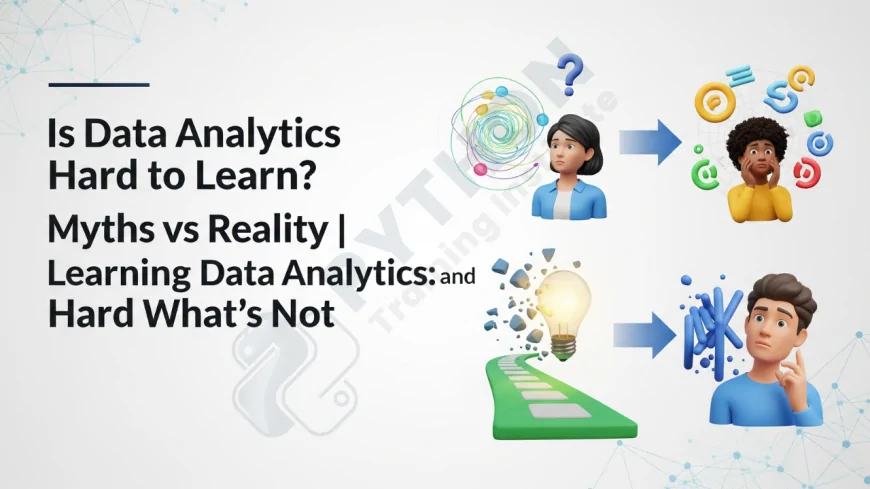
Table of Contents
- Introduction
- What is Data Analytics?
- Why Do People Think It's Hard?
- Common Myths About Data Analytics
- The Reality of Learning Data Analytics
- Skills Required to Succeed
- Popular Tools to Learn
- Can Anyone Learn Data Analytics?
- Best Ways to Learn Data Analytics
- Real-Life Learning Experiences
- How Long Does It Take to Learn?
- Beginner-Friendly Learning Tips
- Challenges Faced by Learners
- Is It Harder Than Coding?
- Do I Need a Math Background?
- Online Courses and Certifications
- Career Impact of Learning Data Analytics
- How to Stay Motivated
- Summary: Myths vs Reality
- FAQs
- Conclusion
Introduction
Many people are intrigued by the world of data but ask themselves: "Is data analytics hard to learn?" The internet is flooded with mixed opinions, but this article will break down myths and reveal the real picture—making it easier for you to decide if a career or skill in data analytics is right for you.
What is Data Analytics?
It is the science of converting raw data into practical, insight-rich conclusions. It involves collecting, cleaning, visualizing, and interpreting data to support decision-making in various industries such as healthcare, finance, marketing, and logistics.
Why Do People Think It's Hard?
People often assume data analytics is hard due to the jargon, coding requirements, or mathematical elements involved. However, many of these fears stem from misconceptions rather than reality.
Common Myths About Data Analytics
- Myth 1: You must be a math genius
- Myth 2: It’s all about coding
- Myth 3: You need a degree in data science
- Myth 4: It’s only for tech professionals
- Myth 5: It takes years to master
The Reality of Learning Data Analytics
The truth is, data analytics is learnable by anyone willing to commit time and practice. Many tools are beginner-friendly, and you can start with no coding background. The key is consistency, curiosity, and hands-on learning.
Skills Required to Succeed
- Basic statistics and probability
- Excel or spreadsheets
- SQL for data queries
- Data visualization (Tableau, Power BI)
- Optional: Python or R for advanced analysis
Popular Tools to Learn
- Microsoft Excel
- Google Sheets
- SQL (MySQL, PostgreSQL)
- Power BI, Tableau
- Python (Pandas, Matplotlib)
Can Anyone Learn Data Analytics?
Yes. People from marketing, HR, finance, sales, and even arts backgrounds are successfully learning data analytics to improve their careers or switch roles entirely.
Best Ways to Learn Data Analytics
- Enroll in beginner-friendly online courses
- Practice with real-world datasets (e.g., Kaggle)
- Build projects and showcase them on GitHub
- Join data communities and forums
Real-Life Learning Experiences
Thousands of learners share their stories online, many of whom had no prior tech background. From career changers to fresh graduates, the path is open to all with discipline and interest.
How Long Does It Take to Learn?
You can become job-ready in 4–6 months with focused effort. Deeper mastery may take 1–2 years, depending on your pace and career goals.
Beginner-Friendly Learning Tips
- Start small—learn one tool at a time
- Focus on practical application over theory
- Watch YouTube tutorials and take notes
- Set weekly learning goals
Challenges Faced by Learners
- Overwhelm from too many tools
- Difficulty in finding real-world projects
- Fear of failure or technical terms
Is It Harder Than Coding?
No. In fact, data analytics is often easier to learn for beginners.You can explore data and build visualizations in Power BI and Excel without touching code.
Do I Need a Math Background?
Basic math is enough. You’ll only need high-level math (like calculus) if you're going into data science or machine learning. For analytics, arithmetic and logic suffice.
Online Courses and Certifications
- Google Data Analytics Certificate (Coursera)
- Microsoft Power BI Data Analyst Associate
- IBM Data Analyst (Coursera)
- Udemy: Data Analytics Bootcamp
Career Impact of Learning Data Analytics
Learning data analytics opens doors to roles like data analyst, BI analyst, marketing analyst, operations analyst, and even freelance consulting. Salaries range from ₹5–18 LPA in India, and $60k–$120k globally.
How to Stay Motivated
- Track progress weekly
- Follow YouTube or LinkedIn mentors
- Celebrate small wins (like finishing a course)
- Join local or virtual study groups
Summary: Myths vs Reality
- Myth: Coding is mandatory → Reality: Excel and SQL are great beginner tools
- Myth: It’s for math pros → Reality: Basic math is sufficient
- Myth: Takes years → Reality: Job-ready in months
- Myth: Only techies can learn → Reality: Anyone can learn with interest
Frequently Asked Questions (FAQs)
1. Is data analytics hard for beginners?
No, it’s quite beginner-friendly with tools like Excel, SQL, and Power BI to get started.
2. Can I learn data analytics without coding?
Yes. You can learn core analytics using no-code tools like Excel, Power BI, and Tableau.
3. How long does it take to learn data analytics?
With regular study, you can become proficient in 4–6 months.
4. Do I need to be good at math?
Only basic arithmetic and logical thinking are needed for most data analytics roles.
5. What are the best tools for beginners?
Start with Excel, SQL, and Tableau or Power BI. Later, explore Python for advanced analytics.
6. Is data analytics the same as data science?
No. Data analytics focuses on current data; data science includes modeling, AI, and predictions.
7. Can non-technical people learn analytics?
Absolutely. Many professionals from finance, marketing, and HR are transitioning into analytics.
8. What kind of jobs can I get?
Data Analyst, Business Intelligence Analyst, Marketing Analyst, Product Analyst, and more.
9. Are certifications necessary?
Not mandatory, but they help validate your skills to employers.
10. Can I learn data analytics online?
Yes. There are many free and paid online courses on Coursera, Udemy, and edX.
11. What salary can a data analyst earn?
In India, ₹5–12 LPA for entry-level; globally, $60,000–$120,000/year.
12. What is the first step to learn data analytics?
Start with Excel and understanding basic statistics. Then move to SQL and visualization tools.
13. Do I need a degree?
No. Projects, skills, and a portfolio matter more than formal degrees in many cases.
14. What are some real-world projects I can try?
Sales dashboard, customer churn analysis, website traffic insights, marketing campaign analysis.
15. Is Python mandatory?
No. It’s optional for more advanced tasks but not needed initially.
16. What industries hire data analysts?
Tech, healthcare, finance, retail, logistics, and government sectors.
17. What’s the difference between BI and data analytics?
BI is more about tools and reporting; data analytics involves interpretation and insights.
18. How do I practice data skills?
Use Kaggle, DataCamp, or GitHub to practice with real datasets.
19. What’s a good beginner project?
Creating a sales dashboard in Excel or Power BI using sample data is a great start.
20. Is data analytics a future-proof career?
Yes. With data driving decisions globally, demand for skilled analysts is continuously rising.
Conclusion
So, is data analytics hard to learn? The answer is: not really. It’s accessible, learnable, and incredibly rewarding. Most of the difficulty comes from myths and misinformation. With the right resources, consistency, and curiosity, anyone can succeed in learning data analytics and leverage it for career growth.
What's Your Reaction?
 Like
0
Like
0
 Dislike
0
Dislike
0
 Love
0
Love
0
 Funny
0
Funny
0
 Angry
0
Angry
0
 Sad
0
Sad
0
 Wow
0
Wow
0