
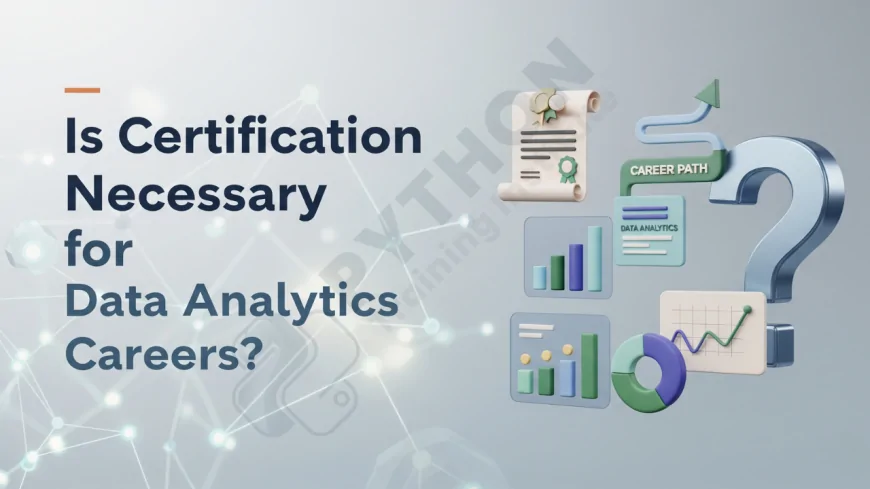
Is Certification Necessary for Data Analytics Careers? | Is Certification the Key to Breaking Into Data Analytics?
Explore whether certifications are essential for a data analytics career. Learn their pros, cons, alternatives, and how employers view them.
Introduction
Data analytics is one of the most in-demand career fields in the digital age. With organizations relying on data-driven decisions, the demand for data analysts continues to rise. Amid this surge in opportunities, one question commonly arises—is certification necessary for a data analytics career?
Importance of Certifications
Certifications have become a popular way for aspiring analysts to demonstrate their skills and dedication. Especially for those without formal academic degrees in data or computer science, certifications often act as a bridge into the analytics domain.
Pros of Getting Certified
- Structured Learning: Certifications offer curated learning paths with hands-on projects.
- Credibility: They validate your skills to employers, particularly when coming from reputed platforms like Coursera, Google, or Microsoft.
- Career Shift: Ideal for professionals transitioning into analytics from other fields.
- Competitive Edge: In a stack of resumes, a certified candidate often stands out.
Cons of Depending Only on Certification
- Not a Silver Bullet: Certifications don't replace real-world problem-solving experience.
- High Cost: Premium certifications can be expensive without guaranteed ROI.
- Overemphasis: Some candidates collect multiple certifications but lack practical experience or portfolio projects.
Real-World Skills vs. Certifications
While a certificate shows you've studied a topic, hiring managers often focus on your ability to apply those skills in real data projects. Tools like Excel, SQL, Python, and Tableau must be mastered practically.
Top Certifications in Data Analytics
- Google Data Analytics Professional Certificate
- Microsoft Certified: Data Analyst Associate
- SAS Certified Specialist: Base Programming
- IBM Data Analyst Professional Certificate
- Cloudera Data Analyst Certification
Is Certification a Job Requirement?
In most cases, no. Certifications are preferred, not required. Recruiters usually prioritize:
- Hands-on experience
- Project portfolios
- Problem-solving ability
- Understanding of business use cases
Alternatives to Certification
- Bootcamps: Immersive programs that offer mentorship and real-time projects.
- Online Courses: From platforms like Udemy, YouTube, Khan Academy, or edX.
- Internships: Practical industry experience matters more than certificates.
- Freelance Projects: Start small to build a meaningful portfolio.
Employer Perspective on Certifications
Many employers see certifications as a sign of initiative and continuous learning, but they rarely use them as the sole criteria for hiring.
Who Should Get Certified?
- Fresh graduates without prior experience
- Career changers from non-tech domains
- Professionals looking to formalize their skills
When Is Certification Most Useful?
Certification is most helpful at the entry level, when you don’t have projects or work experience to demonstrate skills.
Certification vs. Degree vs. Bootcamp
- Degree: Best for theoretical foundation and academic credibility.
- Bootcamp: Best for job-readiness and mentorship.
- Certification: Best for upskilling or proving niche knowledge quickly.
Self-Learning Paths Without Certifications
Many professionals learn through free resources, build GitHub portfolios, and contribute to open data projects—successfully landing jobs without any certificate.
Portfolio Over Certification
A strong portfolio showcasing real-world problem-solving, EDA, dashboards, or predictive modeling always carries more weight than a certificate.
Should Beginners Get Certified?
Yes, if you’re unsure where to start. Certification courses offer structured learning and motivation to complete.
Transitioning Careers Without Certification
It's possible. Learn from online resources, work on practical problems, network via LinkedIn, and demonstrate capabilities through mini-projects.
Industry Trends in 2025
In 2025, employers are leaning more toward practical skills, project portfolios, and business understanding than academic credentials or certificates.
How to Choose the Right Certification
- Choose industry-recognized names (Google, Microsoft, IBM)
- Ensure the syllabus includes hands-on projects
- Look for community and mentor support
- Consider budget and time investment
FAQs
1. Is a certification required to become a data analyst?
No, certification is not mandatory. However, it can boost your credibility and help showcase your skills to employers, especially if you're starting out.
2. Can I get a data analyst job without certification?
Yes, many analysts land jobs through portfolios, internships, and hands-on skills without holding any formal certification.
3. Which data analytics certification is best for beginners?
The Google Data Analytics Professional Certificate is highly recommended for beginners due to its structured content and practical exercises.
4. How much does a data analytics certification cost?
Costs vary widely. Some certifications like Coursera’s start around ₹2,000/month, while advanced ones like SAS or Cloudera may cost ₹50,000 or more.
5. Do certifications guarantee a job in data analytics?
No, certifications don’t guarantee jobs. Your skills, portfolio, and ability to solve business problems are far more important.
6. Are free data analytics certifications useful?
Free certifications can be useful for learning the basics, but may lack industry recognition or depth.
7. How long does it take to complete a certification?
Most certifications take 1–6 months depending on the platform and your pace.
8. Is work experience more important than a certificate?
Yes, most employers prioritize hands-on experience, business knowledge, and problem-solving skills over a certificate.
9. Should I pursue multiple certifications?
One or two relevant certifications are sufficient. Focus more on building real-world projects and skills.
10. Can certification help in career transitions?
Absolutely. Certifications are helpful for career changers who need to validate their new skills and learn industry tools.
11. What are the most recognized certifications in data analytics?
Top certifications include Google Data Analytics, Microsoft Certified Data Analyst, IBM Data Analyst Certificate, and SAS certifications.
12. Do companies ask for certifications during interviews?
Sometimes, but most interviews focus on how you apply your knowledge rather than just your credentials.
13. What’s more important: a certificate or a portfolio?
A portfolio with practical projects, dashboards, and case studies is generally more valuable than a certificate alone.
14. Can I freelance as a data analyst without certification?
Yes, as long as you can prove your expertise through projects, client work, and reviews.
15. What skills should I learn besides getting certified?
Essential skills include SQL, Python, Excel, Tableau or Power BI, and strong communication skills for presenting insights.
16. Do bootcamps offer better training than certificates?
Bootcamps often provide intensive hands-on learning and mentorship, making them a great option if you prefer structured, fast-paced learning.
17. How do I highlight a certification on my resume?
List it under the “Certifications” section and mention key skills or tools you learned. Include links to projects if applicable.
18. Are certifications from platforms like Udemy or edX valid?
Yes, especially if they cover practical tools and are offered by known instructors or institutions. Employer value may vary.
19. Is a master's degree better than a certification?
A master’s degree offers deeper academic knowledge, while certifications are quicker, skill-focused, and ideal for working professionals or career changers.
20. What’s the future of data analytics certifications in 2025?
Certifications will remain helpful for skill validation, but real-world problem-solving, domain knowledge, and portfolio strength will become even more crucial.
Conclusion
So, is certification necessary for a career in data analytics? Not always—but it can help. While it’s not mandatory, certification acts as a strong complement to a practical, hands-on skillset. What matters most in the analytics world is your ability to interpret data, tell a story through insights, and add business value. Use certifications strategically, not as a crutch, but as a stepping stone into your data career.
What's Your Reaction?
 Like
0
Like
0
 Dislike
0
Dislike
0
 Love
0
Love
0
 Funny
0
Funny
0
 Angry
0
Angry
0
 Sad
0
Sad
0
 Wow
0
Wow
0