



Introduction to Predictive Modeling for Analysts | Beginner’s Guide to Predictive Modeling for Analysts
Learn predictive modeling essentials for analysts in 2025. Discover key techniques, tools, challenges, trends, and FAQs to forecast business outcomes.
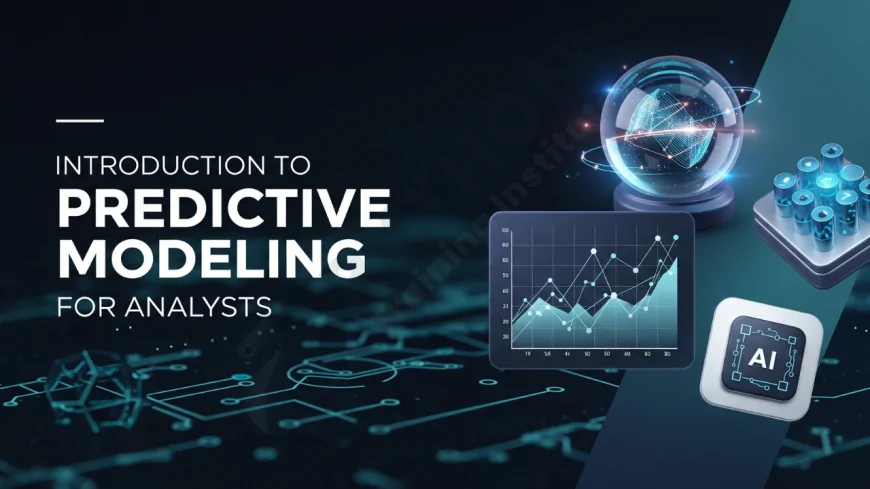
Table of Contents
- Introduction
- What Is Predictive Modeling?
- Business Use Cases & Benefits
- Predictive Modeling Techniques
- Emerging Trends in 2025
- Challenges Analysts Face
- Best Practices for Analysts
- Popular Tools & Platforms
- End‑to‑End Workflow
- FAQs
- Conclusion
Introduction
Predictive modeling is a core skill for data analysts in 2025—enabling professionals to forecast outcomes, optimize decisions, and drive business value. This guide walks analysts through the definition, techniques, emerging trends, common challenges, and practical best practices needed to design reliable predictive models.
What Is Predictive Modeling?
Predictive modeling is a statistical and machine learning approach that learns from historical data to estimate future events or outcomes. It’s a key component of predictive analytics, combining data mining, regression techniques, classification, and time‑series models to uncover patterns and forecast behavior.
Business Use Cases & Benefits
Predictive models are widely used across industries. They forecast customer churn, detect fraud, predict demand, and support financial risk assessment. Organizations using predictive analytics in 2025 enjoy improved decision-making, operational efficiency, and proactive risk management. Businesses that neglect predictive analytics risk 10–20 % revenue decline or missing out on up to $1.3 trillion in opportunities by 2025.
Predictive Modeling Techniques
Key techniques include:
- Regression models (linear, multiple) for numeric prediction
- Classification models (decision trees, logistic regression, random forests, neural networks) for categorical outcomes
- Time-series forecasting such as ARIMA, exponential smoothing, moving averages to predict patterns over time
- Advanced ML models like ensemble methods and deep learning for complex non-linear behaviors
- Conformal prediction for uncertainty quantification and reliable prediction intervals
Emerging Trends in 2025
Top trends shaping predictive modeling include:
- Real‑time predictive analytics for immediate decision-making powered by streaming data and event‑driven systems.
- AutoML and explainable AI (XAI) to democratize modeling and increase transparency.
- Graph AI and quantum-enhanced forecasting emerging for highly complex pattern detection.
- Prescriptive analytics that not only predicts but also suggests optimal actions based on prediction outcomes.
Challenges Analysts Face
Four major challenges for analysts in predictive modeling:
- Data quality & integration issues: fragmented, inconsistent data undermines model accuracy.
- Overfitting and underfitting: balancing model complexity for generalization.
- Lack of clear business objectives or KPIs: leads to low adoption and poor impact.
- Explainability and user trust: complexity often reduces stakeholder confidence in model results.
Best Practices for Analysts
To build reliable predictive models:
- Start with specific business questions and measurable KPIs
- Ensure clean, integrated data for training
- Use cross-validation, regularization, and pruning to avoid overfitting
- Validate model outputs with hold-out and real-world data
- Document assumptions and communicate model limitations clearly
- Implement monitoring for model drift, performance decay, and data shifts
- Adhere to ethical and transparent practices—especially when models impact sensitive decisions.
Popular Tools & Platforms
Common platforms analysts use in 2025 include Azure ML, H2O Driverless AI, IBM Watson Studio, SAS, Microsoft Power BI with predictive modules, and open-source libraries like Scikit-learn, TensorFlow, and Prophet.
End‑to‑End Workflow
Usual workflow steps include:
- Business problem definition
- Data collection, cleaning, integration
- Exploratory data analysis (EDA)
- Feature engineering and selection
- Model selection and training
- Model validation and tuning
- Deployment and monitoring
- Continuous retraining and iteration
Frequently Asked Questions
1. What is the difference between predictive modeling and predictive analytics?
Predictive modeling refers to the technical process of building models. Predictive analytics is the broader discipline that uses those models to inform business decisions.
2. Do analysts need coding skills for predictive modeling?
While many tools support drag‑and‑drop modeling, analysts benefit from knowing Python or R to customize features, tune models, and interpret results.
3. How do I choose the right predictive technique?
Selection depends on the problem type: regression for numeric outcomes, classification for categories, time-series for temporal patterns, and advanced ML for complex relationships.
4. What is overfitting and how can I detect it?
Overfitting occurs when a model mimics noise in training data. Detect it by poor performance on unseen data, and prevent it with cross-validation and regularization.
5. Why is data quality essential?
Poor data with missing values, inconsistencies, or biases reduces model performance and trust. Cleaning and integration are crucial before modeling.
6. What is conformal prediction?
Conformal prediction is a statistical framework that generates prediction intervals with formal guarantees, quantifying uncertainty for each prediction.
7. Is real-time predictive modeling necessary?
Yes for many modern applications—fraud detection, dynamic pricing, and operational automation—where immediate insights drive decisions.
8. How do I ensure explainability in my models?
Use interpretable models, feature importance metrics, SHAP or LIME, and document reasoning to maintain stakeholder trust.
9. How often should models be retrained?
Monitor drift and retrain periodically—every few weeks or months—depending on changes in data patterns or business behavior.
10. Can small datasets be used for predictive modeling?
Yes, but be cautious. Use appropriate techniques (e.g. bootstrapping, cross-validation) and avoid overly complex models to prevent overfitting.
11. Are no-code predictive tools trustworthy?
They’re useful, especially for quick prototypes. But analysts should validate outputs and understand limitations even when using autoML platforms.
12. What are common predictive modeling metrics?
For regression: RMSE, MAE, R². For classification: accuracy, precision, recall, AUC. And for forecasting: MAPE and MASE.
13. Can predictive modeling predict one-time events?
Yes. Models can forecast rare events like equipment failure, rare disease diagnosis, etc., though these often require techniques to handle imbalanced data.
14. What if model predictions are biased?
Audit training data for representation, monitor outcomes by groups, and retrain with fairness-aware algorithms when needed.
15. How do I communicate model outcomes to business users?
Translate results into business context—like ROI impact or risk probabilities—and use visuals or dashboards for clarity.
16. Should I build classification or regression models first?
Start with regression if predicting numerical values; classification if outcomes are categorical. Choose based on business goals.
17. Are cloud platforms better for predictive models?
Cloud platforms like Azure ML and IBM Watson offer scalable infrastructure and automation, but require governance and cost management.
18. What is prescriptive analytics?
Prescriptive analytics builds on predictive modeling by recommending actions to optimize outcomes under constraints.
19. How do I measure model success?
Track accuracy, precision, recall, ROI impact, and user trust. Set baseline metrics and monitor improvements over time.
20. What ethical concerns arise in predictive modeling?
Risk of discrimination, privacy violations, and opaque models. Establish governance, documentation, and clear usage policies to mitigate risks.
Conclusion
For analysts in 2025, predictive modeling is not just a technical task—it’s a strategic enabler. By mastering modern techniques, embracing real-time insights, practicing sound data hygiene, and maintaining transparency, analysts can deliver predictive models that drive tangible business outcomes. Continuous learning and ethical implementation remain essential to sustaining trust and impact in the evolving predictive landscape.
What's Your Reaction?
 Like
0
Like
0
 Dislike
0
Dislike
0
 Love
0
Love
0
 Funny
0
Funny
0
 Angry
0
Angry
0
 Sad
0
Sad
0
 Wow
0
Wow
0