


Future Skills for Data Analytics Jobs in AI Era | AI-Powered Future: What Skills Data Analysts Must Learn
Explore essential future skills for data analytics jobs in the AI era. Learn AI tools, automation, and evolving analyst roles for career growth.
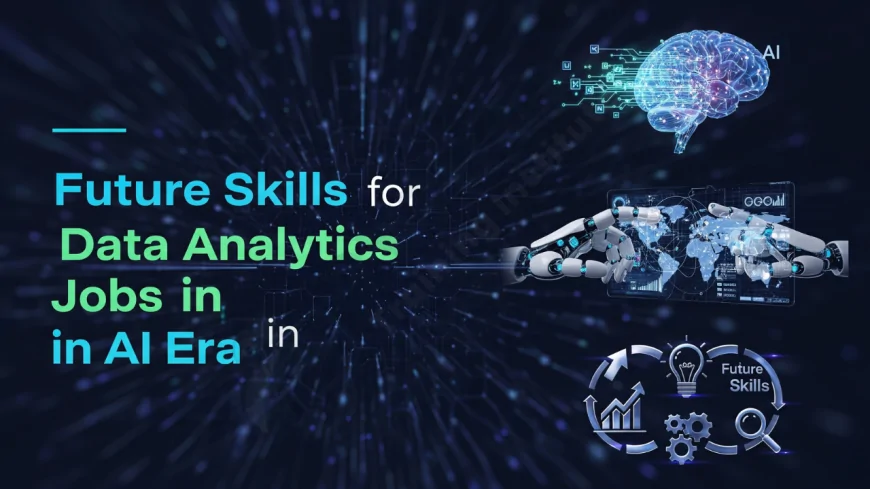
Table of Contents
- Introduction
- How Data Analytics is Evolving with AI
- Why Upskilling is Crucial for Data Professionals
- Top Future Skills Every Analyst Must Learn
- AI and Automation Tools to Master
- Technical Skills for the Next Decade
- Soft Skills in the AI-Driven World
- Importance of Domain-Specific Knowledge
- Future Trends in Data Analytics Careers
- Best Learning Paths and Certifications
- FAQs
- Conclusion
Introduction
As artificial intelligence (AI) and machine learning (ML) continue to transform industries, the field of data analytics is rapidly evolving. Traditional skills are no longer enough. Data professionals must adapt by learning new tools, technologies, and mindsets to remain relevant in the AI-driven future.
How Data Analytics is Evolving with AI
AI is automating many routine analytics tasks such as data cleaning, visualization, and even generating basic insights. As a result, data analysts must move up the value chain—focusing on strategic thinking, deeper modeling, and AI integration.
Why Upskilling is Crucial for Data Professionals
- Automation is replacing repetitive tasks.
- AI tools require understanding of ML workflows.
- Business users expect real-time insights.
- Hybrid roles (analyst + engineer + domain expert) are increasing.
Top Future Skills Every Analyst Must Learn
- AI Literacy: Understand how AI models work, not necessarily build them.
- ML Basics: Concepts like supervised/unsupervised learning, regression, clustering.
- Data Engineering: Knowing how to work with cloud data pipelines and APIs.
- Python Proficiency: Beyond pandas—focus on scikit-learn, TensorFlow, or PyTorch.
- AutoML Tools: Tools like H2O.ai, DataRobot, Google AutoML.
AI and Automation Tools to Master
- ChatGPT and Generative AI for exploratory analysis and code assistance
- Power BI + Copilot for smart visualizations
- Google Cloud AutoML and BigQuery ML
- Azure ML Studio for low-code ML models
- Tableau with AI extensions
Technical Skills for the Next Decade
- Cloud Platforms: AWS, Azure, Google Cloud
- DataOps & MLOps: Automating and monitoring model pipelines
- Data Governance: Privacy, ethics, and compliance (GDPR, HIPAA)
- Advanced SQL: Window functions, CTEs, performance tuning
- Scripting & APIs: Automating data fetch and interaction with services
Soft Skills in the AI-Driven World
While technical skills are important, soft skills will set great analysts apart in the AI age:
- Critical Thinking: Frame problems clearly and challenge assumptions
- Data Storytelling: Translate complex models into business insights
- Agility: Learn and adapt to new tools fast
- Collaboration: Work cross-functionally with engineers, scientists, and business leads
Importance of Domain-Specific Knowledge
AI doesn't eliminate the need for business context. In fact, analysts with domain expertise in healthcare, finance, retail, logistics, or edtech are in higher demand. Tools can change, but understanding customer behavior, revenue models, and KPIs remains irreplaceable.
Future Trends in Data Analytics Careers
- Rise of citizen data scientists using no-code platforms
- Hybrid roles: analytics engineers, data translators
- Increased focus on real-time analytics and edge computing
- Ethical AI and explainability becoming crucial
- Personalized learning and adaptive analytics platforms
Best Learning Paths and Certifications
- Coursera: Google Data Analytics, IBM Data Science, AI for Everyone
- edX: HarvardX Data Science Series, Microsoft Professional Certificates
- Udacity: AI for Business Analysts Nanodegree
- Certifications: AWS Data Analytics, Microsoft PL-300, Google Cloud Data Engineer
FAQs
1. What is the future of data analytics in the age of AI?
Data analytics is becoming more intelligent and automated. Analysts will focus on AI integration, strategy, and decision support.
2. Will AI replace data analysts?
No, but it will change the role. Repetitive tasks will be automated, while human analysts focus on interpretation, ethics, and impact.
3. What AI tools should analysts learn?
ChatGPT, Google AutoML, Tableau with AI, Power BI Copilot, and cloud ML tools are highly relevant.
4. Is Python still necessary in the AI era?
Yes, Python remains the core language for data science and AI workflows.
5. What is AutoML and why is it important?
AutoML platforms automate model selection and tuning, allowing analysts to build models without deep ML expertise.
6. How can analysts stay relevant with AI growth?
By learning new tools, focusing on domain knowledge, and mastering data storytelling and ethical AI.
7. What certifications help future-proof my analytics career?
Look into Google Data Analytics, Microsoft Power BI, and cloud-specific certifications like AWS and GCP.
8. What is data storytelling?
It’s the art of communicating insights clearly using visuals, narratives, and logic to influence decisions.
9. How important is SQL in the future?
Still very important. SQL remains foundational for querying and transforming data, especially in cloud environments.
10. Should I learn machine learning as an analyst?
Basic ML knowledge is a strong plus—it helps collaborate with data scientists and interpret model results.
11. What soft skills should data analysts develop?
Critical thinking, communication, storytelling, and adaptability are essential in the AI age.
12. What is a data translator?
A hybrid role that connects technical data teams with business stakeholders, often in AI projects.
13. What role does cloud computing play in analytics?
Cloud platforms host data warehouses, pipelines, and scalable AI tools—making them essential for modern analytics.
14. Can non-tech professionals transition to analytics in AI era?
Yes. With upskilling in data tools and domain knowledge, many non-tech pros move into analytics roles.
15. Will Excel become obsolete for data analysts?
No, but it will be complemented by more powerful tools like Python, SQL, and BI dashboards.
16. What are citizen data scientists?
Non-technical users using no-code or low-code tools to perform data analysis and build models.
17. How can I build an AI-ready analytics portfolio?
Include projects that show use of ML, dashboards, automated pipelines, and business insights.
18. Is ethical AI relevant for analysts?
Yes. Analysts are often responsible for how data is used, making ethics, bias detection, and privacy essential knowledge.
19. What industries will demand the most AI-literate analysts?
Healthcare, fintech, retail, manufacturing, and logistics are leading in AI adoption.
20. How often should I update my analytics skills?
Continuously. The data field evolves rapidly; quarterly or bi-annual skill refresh is recommended.
Conclusion
The future of data analytics lies at the intersection of technology, human insight, and AI. To thrive, analysts must evolve beyond spreadsheets and dashboards. They must become data strategists, AI collaborators, and ethical stewards of information. With continuous learning, curiosity, and adaptability, data professionals can not only survive but lead in the AI era. Start today—learn smarter, think deeper, and lead with data.
What's Your Reaction?
 Like
0
Like
0
 Dislike
0
Dislike
0
 Love
0
Love
0
 Funny
0
Funny
0
 Angry
0
Angry
0
 Sad
0
Sad
0
 Wow
0
Wow
0