




Data Analyst’s Guide to Learning Hadoop and Spark | Beginner’s Guide to Hadoop and Spark for Data Analysts
A complete guide for data analysts to learn Hadoop and Spark. Understand HDFS, MapReduce, Spark SQL, MLlib, and PySpark with real-world use cases, career tips, and FAQs to boost your big data skills.
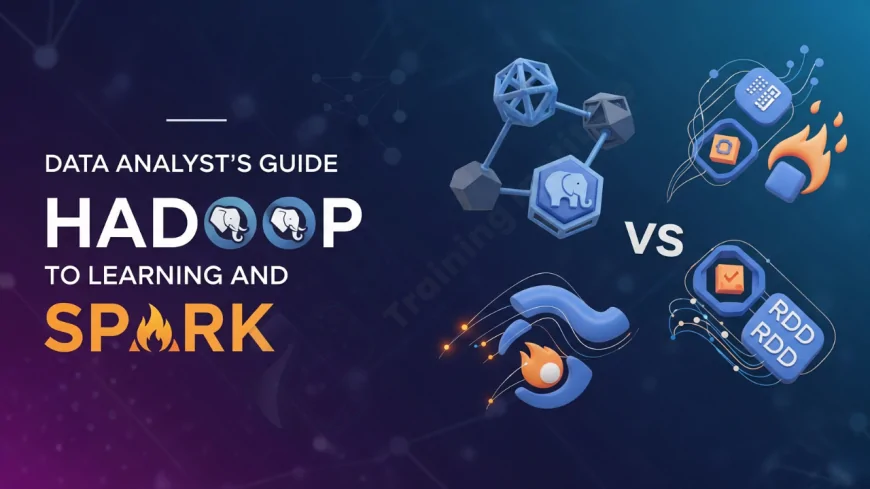
Table of Contents
- Introduction
- Why Hadoop and Spark Matter for Data Analysts
- Hadoop: HDFS, YARN & MapReduce
- Spark: SQL, DataFrames & MLlib
- Hadoop vs Spark: Key Differences
- Analytics Tools in the Ecosystem (Hive, Pig, etc.)
- Sample Learning Path for Analysts
- Practical Use Cases for Analysts
- Skills Employers Look For (2025)
- Career Roles and Progression
- Common Challenges & Tips to Overcome
- FAQs
- Conclusion
Introduction
When dealing with massive datasets, data analysts benefit greatly from distributed computing tools like Apache Hadoop and Apache Spark. Understanding how to use these platforms—alongside traditional analytics workflows—can open doors in industries handling big data at scale.
Why Hadoop and Spark Matter for Data Analysts
In 2025, many analytics roles expect familiarity with big data frameworks: Hadoop and Spark provide access to large-scale processing, SQL query capabilities over big datasets, and machine learning support—all of which extend an analyst’s capabilities beyond local tools like Excel or pandas.
Hadoop: HDFS, YARN & MapReduce
Hadoop is built around two core components: HDFS for distributed storage and MapReduce for parallel batch processing. HDFS splits files among cluster nodes and MapReduce performs key/value-based transformations using mappers and reducers. Resource scheduling is managed through YARN.
Spark: SQL, DataFrames & MLlib
Apache Spark is a unified analytics engine providing fast in-memory computation, support for SQL queries (Spark SQL), DataFrames, streaming, and machine learning via MLlib. Spark’s APIs for Python, Scala, R, Java enable rapid prototyping at scale. Version 4.0 was released May 23, 2025.
Hadoop vs Spark: Key Differences
- Processing: Hadoop MapReduce uses disk-based batch processing; Spark processes in memory for faster iterative operations.
- Latency: Spark is optimized for low-latency and streaming; Hadoop is suited for high-throughput batch workloads.
- Use cases: Hadoop is stable for fault-tolerant batch jobs; Spark excels at interactive analytics, machine learning, and real-time processing.
Analytics Tools in the Ecosystem (Hive, Pig, etc.)
Hadoop’s ecosystem includes Hive (SQL on Hadoop), Pig (Pig Latin scripting), HBase, and others. Many of these integrate with Spark for hybrid processing (e.g. Hive on Spark). Analysts often use HiveQL or SparkSQL interfaces to query large data without deep Java/Scala coding.
Sample Learning Path for Analysts
- Start with an introductory course such as IBM’s “Introduction to Big Data with Spark and Hadoop” on Coursera.
- Learn HDFS fundamentals, data loading, and MapReduce concepts.
- Move to Spark SQL, DataFrames, and basic PySpark coding.
- Explore MLlib for simple machine learning workflows inside Spark.
- Practice in environments like Zeppelin, Databricks, or local Docker/Kubernetes clusters.
Practical Use Cases for Analysts
- Processing large transaction datasets or server logs using Spark SQL.
- Performing clustering or classification at scale with MLlib.
- Running batch ETL pipelines via Hadoop + Hive.
- Using Spark Streaming for real-time analytics on streaming data.
Skills Employers Look For (2025)
Surveys highlight that analysts in 2025 must combine analytics, business context, and big data technical skills such as Spark and Hadoop. Employers prefer familiarity with Python/scala, SQL, distributed frameworks and cloud-based deployment.
Career Roles and Progression
Early-career analysts begin with querying and visualization. With Hadoop and Spark skills, you can progress to hybrid analyst-engineer roles, data engineering, or big-data insights roles in industries like finance, telecom, IoT analytics. DataCamp and other reports emphasize Spark and Hadoop in resumes for such roles.
Common Challenges & Tips to Overcome
- Complex setup: Use sandbox environments like Docker or managed platforms.
- Debugging distributed jobs: Understand Spark UI and logs.
- Resource tuning: Learn default configs, executor memory, and partitioning basics.
- Choosing tool: If real-time, use Spark; for massive batch ETL, Hadoop may suffice.
FAQs –
1. Can data analysts use Hadoop without being data engineers?
Yes. Analysts often use tools such as Hive or SparkSQL on Hadoop without needing deep engineering skills—focusing on analytics rather than cluster operations.
2. Is Spark more useful than Hadoop for analysts?
Often yes—Spark’s speed, SQL interface, and machine learning integration make it more accessible and valuable for analysis.
3. What programming languages do analysts use with Spark?
Python (with PySpark), SQL, and sometimes Scala or R—depending on the environment. Python is most common.
4. What is MapReduce?
A programming model used in Hadoop that processes large-scale data using map and reduce functions over key/value pairs.
5. What is MLlib?
MLlib is Spark’s machine learning library, supporting classification, regression, clustering, and collaborative filtering in distributed fashion.
6. What is HDFS?
HDFS is Hadoop's distributed file system, splitting data into blocks across cluster nodes and replicating for fault tolerance.
7. Do I need to know cloud platforms?
Yes—many deployments rely on cloud services like AWS EMR, Databricks, or Google Dataproc that manage Hadoop/Spark clusters.
8. Is Hive easier than SparkSQL?
Hive uses SQL-like syntax for Hadoop and is easier for analysts familiar with SQL, but SparkSQL offers faster performance and richer capabilities.
9. How long to learn basics?
With consistent effort, analysts can grasp basics in 4‑6 weeks using structured courses and labs.
10. How do I practice Hadoop and Spark?
Use online sandboxes (e.g. IBM labs, Databricks Community Edition, Docker clusters) and follow guided projects.
11. What use cases are common?
Log processing, large-scale ETL, clustering, regression modeling at scale, real-time stream processing.
12. Should I learn both Hadoop and Spark?
Yes—knowing Hadoop basics (HDFS, MapReduce) along with Spark lets you adapt to most big data workflows.
13. What is YARN?
YARN is Hadoop’s resource management and scheduling layer enabling multiple
14. Can Spark replace Hadoop?
Spark can operate independently of Hadoop but often runs on top of HDFS and uses YARN; depending on requirements, Hadoop-only setups may suffice.
15. What roles use Hadoop & Spark?
Big Data Analysts, Data Engineers, Analytics Engineers, and ML Engineers all use these platforms depending on focus.
16. How does Spark handle streaming?
Spark supports structured streaming for event-by-event or micro-batch real-time data processing.
17. What industries use these tools?
Telecom, finance, manufacturing, healthcare, ad-tech, IoT analytics and more—any industry handling large datasets.
18. How can I show these skills on my resume?
Include projects using Spark SQL, PySpark, Hadoop ETL tasks, or cluster-based analytics demos.
19. What’s next after learning Hadoop & Spark?
Explore real-time tools (Kafka, Flink), orchestration (Airflow), cloud analytics stacks, and MLops pipelines.
20. Why Hadoop still matters?
Hadoop remains foundational for reliable, scalable storage and batch systems in many legacy and enterprise setups.
Conclusion
For data analysts working with big datasets, mastering Hadoop and Spark unlocks new capabilities—from scalable data processing to predictive analytics via MLlib. While Hadoop handles resilient batch storage and processing, Spark brings speed, interactivity, and flexibility for analytics. A learning path that includes HDFS, Spark SQL, PySpark and practical labs will build your credibility and prepare you to work effectively in modern, big‑data-driven analytics environments.
What's Your Reaction?
 Like
0
Like
0
 Dislike
0
Dislike
0
 Love
0
Love
0
 Funny
0
Funny
0
 Angry
0
Angry
0
 Sad
0
Sad
0
 Wow
0
Wow
0