


Business Analytics vs Data Analytics Careers | Data Analytics vs Business Analytics Careers: Key Differences
Explore the differences between business analytics and data analytics careers. Learn key skills, job roles, salary trends, and which path is right for your career goals.
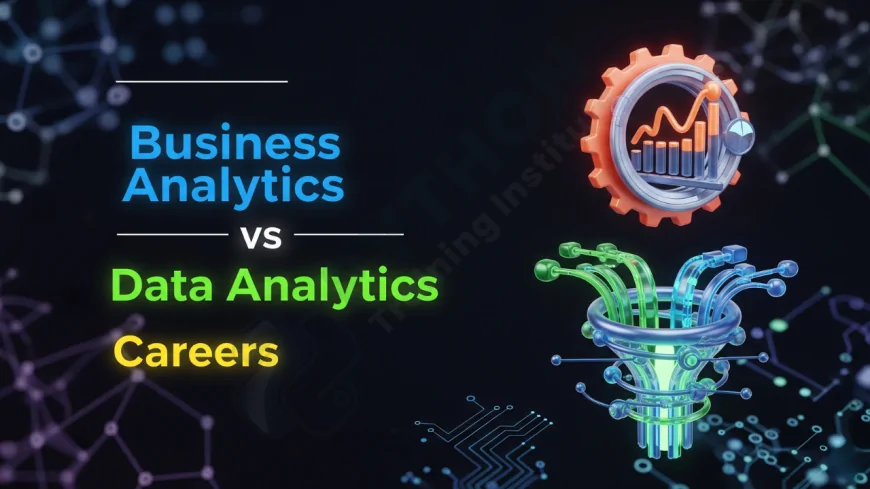
Table of Contents
- Introduction
- What Is Business Analytics?
- What Is Data Analytics?
- Key Differences Between Business and Data Analytics
- Skills Required for Both Careers
- Popular Tools in Business vs Data Analytics
- Job Roles and Responsibilities
- Career Progression and Growth Opportunities
- Industry Demand and Application Areas
- Salary Comparison: BA vs DA
- Educational Background and Certifications
- Real-World Scenarios: Who Does What?
- Challenges in Each Role
- Can You Switch Between BA and DA?
- Freelancing vs Full-Time in Both Careers
- Which Career Path Is Better for You?
- Future Trends in Business and Data Analytics
- Summary Table: Business vs Data Analytics
- FAQs
- Conclusion
Introduction
Analytics is one of the fastest-growing fields in today’s data-driven world. If you're choosing between a career in Business Analytics (BA) and Data Analytics (DA), understanding the differences is crucial. Both roles offer dynamic opportunities but cater to different strengths, tools, and career paths.
What Is Business Analytics?
The goal of Business Analytics is to turn raw data into solutions that address key business needs. It blends data with domain knowledge to recommend strategies and support decision-making processes. Business Analysts work closely with stakeholders and often bridge technical and non-technical teams.
What Is Data Analytics?
Data Analytics, on the other hand, is more technical. Data Analysts examine large datasets to uncover patterns, trends, and insights. Their focus is often deeper on data manipulation, visualization, and statistical modeling, sometimes venturing into machine learning.
Key Differences Between Business and Data Analytics
- Focus: BA focuses on business problems; DA focuses on data interpretation.
- Tools: BA uses Excel, Power BI, and ERP tools. DA leans on SQL, Python, and R.
- Audience: BA interacts more with management; DA may work closely with engineers or data scientists.
Skills Required for Both Careers
Business Analytics:
- Domain knowledge (finance, marketing, operations)
- Critical thinking and communication
- Business Intelligence tools
Data Analytics:
- Programming (Python, R)
- Statistical analysis
- Data cleaning and visualization
Popular Tools in Business vs Data Analytics
- Business Analytics: Power BI, Tableau, Excel, SAP, Salesforce
- Data Analytics: SQL, Python, R, Jupyter Notebook, Google BigQuery
Job Roles and Responsibilities
- Business Analyst: Requirement gathering, stakeholder meetings, dashboard building, making business recommendations.
- Data Analyst: Extracting data, data wrangling, visualizing trends, supporting predictive modeling.
Career Progression and Growth Opportunities
Business Analysts can move into roles like Product Manager, Project Manager, or Strategy Consultant. Data Analysts often progress into Data Scientists, ML Engineers, or Analytics Engineers.
Industry Demand and Application Areas
- Business Analytics: Consulting, Retail, Banking, Logistics
- Data Analytics: Tech, E-commerce, HealthTech, FinTech
Salary Comparison: BA vs DA
- Business Analyst Average Salary (India): ₹6 – ₹10 LPA
- Data Analyst Average Salary (India): ₹5 – ₹12 LPA
- US Market: DA roles tend to have slightly higher starting packages due to technical depth.
Educational Background and Certifications
- BA: MBA, BBA, or commerce-related degrees + certifications like CBAP or PMI-PBA.
- DA: Educational qualifications for data analysts include BSc, BTech, or degrees in Math, Stats, or CS, along with certifications such as Google Data Analytics, IBM Data Analyst, or Microsoft Certified: Data Analyst Associate.
Real-World Scenarios: Who Does What?
Suppose a retail company faces declining sales. A Business Analyst will analyze market trends and propose campaign strategies. A Data Analyst will dig into product performance, customer behavior, and sales data to uncover actionable insights.
Challenges in Each Role
- BA: Ambiguous requirements, resistance to change, stakeholder alignment
- DA: Poor data quality, complex datasets, limited access to systems
Can You Switch Between BA and DA?
Yes. A business analyst can learn SQL and Python to move into DA. Data analysts who build a strong understanding of business processes can successfully pivot to business analyst positions. The transition is feasible with proper upskilling.
Freelancing vs Full-Time in Both Careers
Platforms like Upwork, Fiverr, and Toptal have made freelancing more attainable for data analysts. Business analysts also freelance but usually with experience in consulting or niche domains.
Which Career Path Is Better for You?
If you enjoy strategy, business communication, and client interaction—choose Business Analytics. If you love coding, data exploration, and statistical thinking—Data Analytics is your path.
Future Trends in Business and Data Analytics
- Automation and AI will reshape both fields
- Hybrid roles (Business Data Analyst) are emerging
- Cloud-based analytics platforms are growing
Summary Table: Business vs Data Analytics
| Aspect | Business Analytics | Data Analytics |
|---|---|---|
| Focus | Business strategy | Data insights |
| Skills | Communication, business tools | Programming, stats |
| Tools | Excel, Power BI | SQL, Python |
| Average Salary | ₹6–10 LPA | ₹5–12 LPA |
| Growth | Product Manager, Consultant | Data Scientist, ML Engineer |
Frequently Asked Questions (FAQs)
1. What is the main difference between business and data analytics?
Business analytics focuses on solving business problems, while data analytics focuses on exploring and interpreting raw data.
2. Which role is more technical?
Data Analyst roles are more technical and involve programming, statistics, and data engineering skills.
3. Is coding required for business analytics?
Basic knowledge of tools like Excel or Power BI is needed, but coding is usually optional for BA roles.
4. Can I switch between business and data analytics careers?
Yes, with upskilling and experience, professionals often move between the two fields.
5. Which role pays more?
Data analysts may earn slightly more initially due to technical skills, but BA roles offer lucrative long-term growth.
6. Do I need an MBA to be a business analyst?
Not necessarily, but an MBA can enhance your business acumen and job prospects.
7. What industries hire business analysts?
Finance, retail, logistics, healthcare, and consulting frequently hire BAs.
8. Are data analysts in demand?
Yes, data analysts are in high demand across tech, ecommerce, and finance industries.
9. Which certifications help in these careers?
CBAP, PMI-PBA (for BA); Google Data Analytics, Microsoft Data Analyst (for DA)
10. Can I freelance as a data analyst?
Yes, many platforms offer freelance data analyst gigs globally.
11. Do both roles use SQL?
Yes, but data analysts use SQL more intensively for querying and reporting.
12. What soft skills do business analysts need?
Communication, negotiation, stakeholder management, and analytical thinking.
13. What projects do data analysts work on?
Customer segmentation, sales trend analysis, churn prediction, and dashboard creation.
14. Are internships available in both fields?
Yes, many companies offer internships in both BA and DA with hands-on training.
15. Is Python needed for data analytics?
Yes, Python is a must-have skill for advanced data analysis and modeling.
16. What is a hybrid analyst role?
It's a role that combines business analysis and data analysis responsibilities.
17. Can I work remotely in both careers?
Yes, remote opportunities are available for both roles in many companies.
18. Is data science part of data analytics?
Data analytics is a subset of data science, which also includes AI and machine learning.
19. Do I need advanced math for either career?
Only basic statistics for BA; more advanced math is preferred for DA.
20. Which is better for long-term growth?
Both offer great growth. BA leads to strategic roles, DA can lead to data science or engineering roles.
Conclusion
Both Business Analytics and Data Analytics careers offer rich, rewarding opportunities. Whether you're driven by business impact or data exploration, each path has growth, high demand, and job security. Choose based on your interests, strengths, and long-term goals—and don’t hesitate to switch if your passion evolves.
What's Your Reaction?
 Like
0
Like
0
 Dislike
0
Dislike
0
 Love
0
Love
0
 Funny
0
Funny
0
 Angry
0
Angry
0
 Sad
0
Sad
0
 Wow
0
Wow
0